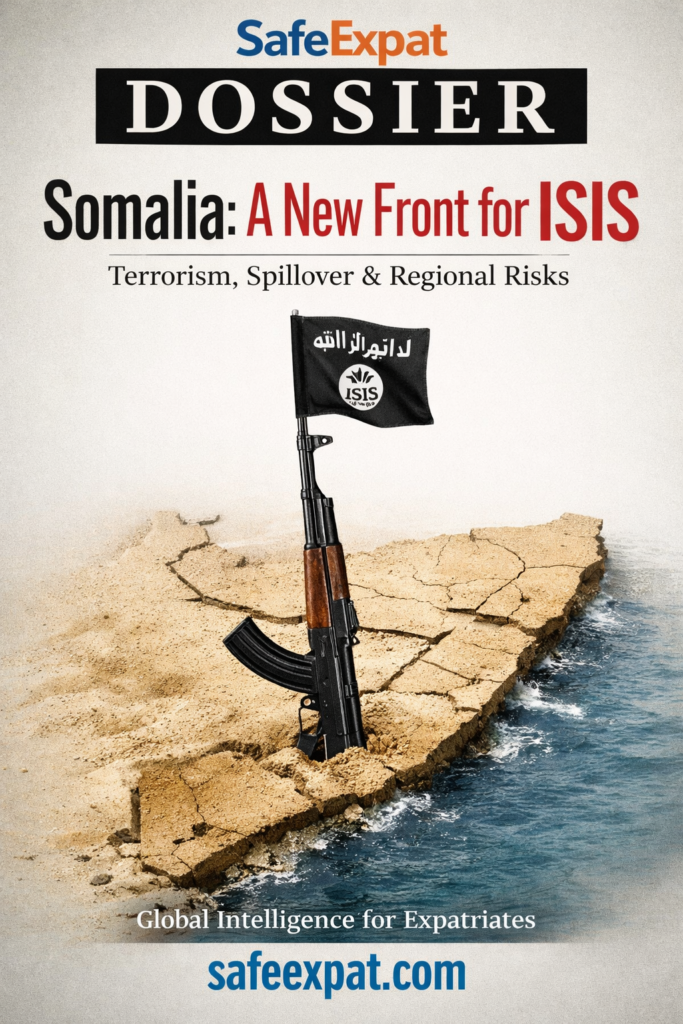
Publication Date: April 11, 2026
Geographic Scope: Somalia (Primary: Puntland; Secondary: Horn of Africa Region)
Risk Classification: High
Executive Abstract
The emergence of Islamic State (IS) operational capabilities in northeastern Somalia marks a significant evolution in the Horn of Africa’s security landscape.
While historically overshadowed by Al-Shabaab, IS elements in Puntland are demonstrating growing resilience, adaptability, and transnational connectivity.
This development introduces new layers of risk for residents, operators, and investors, particularly in environments where governance fragmentation and security asymmetry persist.
1️⃣ EXECUTIVE INTELLIGENCE BRIEF
Five Key Findings
- Islamic State presence in Puntland has shifted from marginal insurgency to structured operational foothold.
- Fragmented governance between federal Somalia and regional administrations limits coordinated counterterrorism responses.
- IS exploits geographic isolation, weak infrastructure, and maritime corridors to sustain operations.
- Increased competition between jihadist groups (IS vs. Al-Shabaab) creates unpredictable violence patterns.
- External actors (UAE, US, Turkey) influence security dynamics, but coordination gaps remain.
Three Emerging Risks
- Expansion of IS influence into logistical and financial networks beyond Puntland.
- Maritime security threats affecting Red Sea and Gulf of Aden trade routes.
- Increased targeting of foreign personnel and soft economic infrastructure.
Three Strategic Recommendations
- Avoid overreliance on localized security guarantees in Puntland.
- Implement layered risk monitoring systems incorporating regional intelligence.
- Establish contingency evacuation and operational redundancy frameworks.
Overall Risk Rating: High
Most Exposed Groups
- Foreign contractors and NGOs operating in northern Somalia
- Maritime logistics operators and shipping-linked businesses
- Local residents in Puntland urban peripheries
- Regional investors in infrastructure or telecom sectors
- Remote professionals dependent on local stability (journalists, consultants)
2️⃣ STRATEGIC CONTEXT
Why This Issue Matters Now
The evolution of Somalia into a dual-front jihadist environment represents a structural shift rather than an isolated development. For over a decade, security analysis in Somalia has been dominated by Al-Shabaab. However, the consolidation of Islamic State factions in Puntland introduces:
- A second insurgent ecosystem
- Competing ideological and operational agendas
- Fragmented security responses
This is not merely a security issue—it is an operational environment transformation.
Recent Developments
- Increased Puntland military operations targeting IS mountain strongholds
- Evidence of IS recruitment pipelines linking Somalia to broader East African networks
- Intensified international intelligence interest in northeastern Somalia
- Reports of foreign fighters and tactical advisors entering Puntland regions
Structural Forces
- Weak central governance and limited federal reach
- Clan dynamics influencing territorial control
- Geographic isolation of Puntland’s mountainous terrain
- Economic marginalization fueling recruitment
Regional and Global Influences
- Red Sea security concerns tied to global trade routes
- Gulf state strategic competition in the Horn of Africa
- Shifting counterterrorism priorities among Western actors
Why Misjudgment Creates Risk
Misinterpreting Somalia as a “single-threat environment” leads to:
- Underestimating volatility
- Inadequate security planning
- Misaligned investment risk assessments
The operating environment is dynamic, multi-layered, and rapidly evolving.
3️⃣ MULTI-DIMENSIONAL RISK ANALYSIS
A. Economic & Financial Exposure
Primary Risks
- Disruption of local economies due to conflict escalation
- Informal taxation/extortion by armed groups
- Instability affecting currency and financial flows
Secondary Risks
- Reduced foreign investment confidence
- Increased insurance premiums for regional operations
- Supply chain fragmentation
Probability: High
Impact: High
Most Exposed
- SMEs operating in Puntland
- Logistics and port-linked businesses
- Telecom and fintech operators
B. Legal & Regulatory Risk
Primary Risks
- Weak enforcement of contracts
- Overlapping authority between federal and regional governments
- Informal governance structures influencing legal outcomes
Secondary Risks
- Exposure to sanctions-related compliance risks
- Difficulty in dispute resolution
- Regulatory unpredictability
Probability: High
Impact: Medium–High
Most Exposed
- Foreign investors
- NGOs
- Contractors engaged in infrastructure or development
C. Safety & Stability Factors
Primary Risks
- Armed conflict between IS, Al-Shabaab, and local forces
- Targeted attacks on civilians and foreign personnel
- Urban infiltration by insurgent networks
Secondary Risks
- Collateral damage from military operations
- Kidnapping and hostage risks
- Internal displacement increasing instability
Probability: High
Impact: High
Most Exposed
- Local populations in contested areas
- Foreign staff and journalists
- Aid organizations
D. Operational & Administrative Friction
Primary Risks
- Limited infrastructure (roads, communications)
- Restricted mobility due to security concerns
- Difficulty accessing reliable local partners
Secondary Risks
- Administrative delays
- Informal checkpoints and taxation
- Communication blackouts during operations
Probability: High
Impact: Medium–High
Most Exposed
- Field operators
- NGOs
- Remote workers relying on connectivity
4️⃣ SCENARIO ANALYSIS
Scenario 1: Gradual IS Entrenchment
Description: IS consolidates control in Puntland’s remote regions without major territorial expansion.
- Probability: High
- Impact: Medium–High
Early Indicators
- Increased recruitment activity
- Stabilization of IS-controlled zones
- Reduced frequency but increased sophistication of attacks
Mitigation
- Avoid operational presence in rural Puntland
- Enhance intelligence partnerships
- Diversify regional exposure
Scenario 2: Escalation into Multi-Front Conflict
Description: Intensified clashes between IS, Al-Shabaab, and Puntland forces.
- Probability: Medium
- Impact: High
Early Indicators
- Rising attack frequency
- Civilian displacement spikes
- Competing propaganda campaigns
Mitigation
- Evacuation planning
- Reduced physical footprint
- Remote operational models
Scenario 3: Regional Spillover
Description: IS expands influence into neighboring regions or maritime routes.
- Probability: Medium
- Impact: High
Early Indicators
- Cross-border incidents
- Increased maritime threats
- Intelligence alerts from regional actors
Mitigation
- Maritime security protocols
- Regional risk diversification
- Insurance reassessment
Scenario 4: Containment Through External Intervention
Description: Coordinated international support strengthens Puntland’s counterterrorism capacity.
- Probability: Low–Medium
- Impact: Medium
Early Indicators
- Increased foreign military assistance
- Joint operations
- Improved intelligence sharing
Mitigation
- Gradual re-engagement strategies
- Monitoring stabilization signals
- Controlled exposure expansion
5️⃣ PRACTICAL RISK MITIGATION PLAYBOOK
Preparation Checklist
- Conduct region-specific threat assessments
- Identify evacuation routes and safe zones
- Vet local partners extensively
Financial Safeguards
- Diversify financial exposure
- Secure political risk insurance
- Maintain offshore liquidity reserves
Legal & Compliance
- Conduct sanctions screening
- Understand regional governance structures
- Use international arbitration clauses where possible
Insurance Considerations
- Kidnap & ransom insurance
- Political violence coverage
- Business interruption insurance
Contingency Planning
- Crisis communication protocols
- Remote work transition capability
- Staff relocation frameworks
Ongoing Monitoring Checklist
- Track security incidents in Puntland
- Monitor regional political developments
- Assess changes in international engagement
6️⃣ EXPOSURE PATTERNS & CASE INSIGHTS
Case 1: NGO Operational Miscalculation
An NGO expanded operations into Puntland based on outdated security assessments.
Outcome
- Staff evacuation required
- Program suspension
- Financial losses
Lesson
Static risk assessments are insufficient in dynamic environments.
Case 2: Logistics Operator Exposure
A regional logistics firm underestimated maritime spillover risks.
Outcome
- Increased insurance costs
- Route disruptions
- Contract renegotiations
Lesson
Security developments inland can affect maritime operations.
Case 3: Investor Overconfidence
An investor relied on local guarantees for infrastructure development.
Outcome
- Project delays
- Contract disputes
- Regulatory ambiguity
Lesson
Local assurances cannot replace structured risk intelligence.
7️⃣ 6–12 MONTH OUTLOOK
Expected Trajectory
- Continued IS presence with gradual capability enhancement
- Persistent fragmentation in security responses
- Increased international attention but limited coordination
Signals to Monitor
- Puntland military effectiveness
- IS recruitment patterns
- External actor involvement
Indicators of Escalation
- Urban attacks
- Maritime incidents
- Cross-border activity
Indicators of Stabilization
- Reduced attack frequency
- Improved governance coordination
- Sustained counterterrorism success
Trigger Points
- Leadership changes within insurgent groups
- External intervention shifts
- Regional geopolitical developments
8️⃣ STRATEGIC CONCLUSION
Core Exposure Level: High
Somalia—particularly Puntland—now represents a multi-layered risk environment where traditional threat models no longer apply.
Who Should Proceed with Caution
- Foreign operators
- NGOs
- Investors in infrastructure or logistics
Who May Find Opportunities
- Specialized security and risk consulting firms
- Organizations with high-risk operational expertise
- Entities capable of remote or low-footprint engagement
Strategic Positioning
- Prioritize flexibility over fixed investments
- Maintain regional diversification
- Integrate continuous intelligence monitoring
🔟 WHY ONGOING INTELLIGENCE MATTERS
Operating in environments such as Somalia requires recognition of a fundamental asymmetry: risk evolves faster than static analysis.
Reactive decision-making often leads to:
- Financial losses from disrupted operations
- Legal exposure due to regulatory misalignment
- Personal risk to staff and dependents
Fragmented or outdated information compounds this exposure by:
- Creating false confidence
- Obscuring emerging threats
- Delaying critical response decisions
In contrast, structured and continuous monitoring enables:
- Early identification of risk signals
- Timely operational adjustments
- Strategic allocation of resources
In complex environments like Puntland, where security, governance, and economic conditions shift simultaneously, the cost of incomplete intelligence is disproportionately high.
SafeExpat’s structured intelligence approach supports:
- Cross-border situational awareness
- Forward-looking risk analysis
- Decision-making grounded in evolving realities
For globally mobile individuals and organizations, the ability to adapt in real time is not an advantage—it is a necessity.
ready formatted for a wordpress post no html
SafeExpat Dossier #27
Somalia as a New Operational Front for the Islamic State: Security Fragmentation, Regional Spillover, and Exposure Risks in Puntland
Publication Date: April 11, 2026
Geographic Scope: Somalia (Primary: Puntland; Secondary: Horn of Africa Region)
Risk Classification: High
Executive Abstract
The emergence of Islamic State (IS) operational capabilities in northeastern Somalia marks a significant evolution in the Horn of Africa’s security landscape.
While historically overshadowed by Al-Shabaab, IS elements in Puntland are demonstrating growing resilience, adaptability, and transnational connectivity.
This development introduces new layers of risk for residents, operators, and investors, particularly in environments where governance fragmentation and security asymmetry persist.
1️⃣ Executive Intelligence Brief
Five Key Findings
- Islamic State presence in Puntland has shifted from marginal insurgency to structured operational foothold.
- Fragmented governance between federal Somalia and regional administrations limits coordinated counterterrorism responses.
- IS exploits geographic isolation, weak infrastructure, and maritime corridors to sustain operations.
- Increased competition between jihadist groups creates unpredictable violence patterns.
- External actors influence security dynamics, but coordination gaps remain.
Three Emerging Risks
- Expansion of IS influence into logistical and financial networks beyond Puntland
- Maritime security threats affecting Red Sea and Gulf of Aden trade routes
- Increased targeting of foreign personnel and economic infrastructure
Three Strategic Recommendations
- Avoid overreliance on localized security guarantees in Puntland
- Implement layered risk monitoring systems incorporating regional intelligence
- Establish contingency evacuation and operational redundancy frameworks
Overall Risk Rating
High
Most Exposed Groups
- Foreign contractors and NGOs operating in northern Somalia
- Maritime logistics operators and shipping-linked businesses
- Local residents in Puntland urban peripheries
- Regional investors in infrastructure or telecom sectors
- Remote professionals dependent on local stability
2️⃣ Strategic Context
Why This Issue Matters Now
The evolution of Somalia into a dual-front jihadist environment represents a structural shift rather than an isolated development. For years, security dynamics were dominated by a single primary actor. The consolidation of Islamic State factions in Puntland introduces competing insurgent ecosystems, fragmented responses, and higher unpredictability.
This is not only a security concern. It is a transformation of the operational environment.
Recent Developments
- Intensified Puntland military operations targeting IS strongholds
- Evidence of expanding recruitment networks across East Africa
- Increased international intelligence focus on northeastern Somalia
- Reports of foreign fighters supporting local IS factions
Structural Forces
- Weak central governance and limited federal reach
- Clan dynamics influencing territorial control
- Geographic isolation of Puntland’s mountainous terrain
- Economic marginalization driving recruitment
Regional and Global Influences
- Strategic importance of Red Sea trade corridors
- Gulf state competition in the Horn of Africa
- Shifting priorities among international counterterrorism actors
Why Misjudgment Creates Risk
Treating Somalia as a single-threat environment leads to underestimating volatility and misaligned planning. The current landscape requires multi-layered risk assessment and continuous monitoring.
3️⃣ Multi-Dimensional Risk Analysis
A. Economic & Financial Exposure
Primary Risks
- Conflict-driven disruption of local economic activity
- Informal taxation and extortion by armed groups
- Instability affecting financial flows
Secondary Risks
- Declining investor confidence
- Rising insurance costs
- Supply chain fragmentation
Probability: High
Impact: High
Most Exposed
- Local businesses and SMEs
- Logistics and port-linked operators
- Telecom and financial service providers
B. Legal & Regulatory Risk
Primary Risks
- Weak contract enforcement
- Overlapping federal and regional authority
- Informal governance influence
Secondary Risks
- Sanctions-related compliance exposure
- Limited dispute resolution mechanisms
- Regulatory unpredictability
Probability: High
Impact: Medium–High
Most Exposed
- Foreign investors
- NGOs
- Infrastructure contractors
C. Safety & Stability Factors
Primary Risks
- Armed conflict between multiple jihadist actors and local forces
- Targeted attacks on civilians and foreign personnel
- Urban infiltration by insurgent networks
Secondary Risks
- Collateral damage from military operations
- Kidnapping risks
- Internal displacement pressures
Probability: High
Impact: High
Most Exposed
- Local populations
- Foreign staff and journalists
- Aid organizations
D. Operational & Administrative Friction
Primary Risks
- Limited infrastructure and connectivity
- Restricted mobility due to insecurity
- Difficulty identifying reliable partners
Secondary Risks
- Administrative delays
- Informal checkpoints and taxation
- Communication disruptions
Probability: High
Impact: Medium–High
Most Exposed
- Field operators
- NGOs
- Remote professionals
4️⃣ Scenario Analysis
Scenario 1: Gradual IS Entrenchment
Description: IS consolidates its presence in remote Puntland regions without major expansion
- Probability: High
- Impact: Medium–High
Early Indicators
- Stable IS-controlled zones
- Continued recruitment activity
- Fewer but more sophisticated attacks
Mitigation Strategies
- Limit presence in rural Puntland
- Strengthen intelligence partnerships
- Diversify regional exposure
Scenario 2: Multi-Front Escalation
Description: Increased clashes between IS, rival groups, and Puntland forces
- Probability: Medium
- Impact: High
Early Indicators
- Increased frequency of attacks
- Rising displacement levels
- Competing propaganda output
Mitigation Strategies
- Activate evacuation protocols
- Reduce physical footprint
- Shift to remote operations
Scenario 3: Regional Spillover
Description: Expansion of IS activity beyond Puntland, including maritime disruption
- Probability: Medium
- Impact: High
Early Indicators
- Cross-border incidents
- Maritime security alerts
- Increased regional intelligence activity
Mitigation Strategies
- Enhance maritime security planning
- Diversify operational geography
- Reassess insurance coverage
Scenario 4: External Containment
Description: Improved counterterrorism capacity through international support
- Probability: Low–Medium
- Impact: Medium
Early Indicators
- Increased foreign assistance
- Coordinated military operations
- Improved intelligence sharing
Mitigation Strategies
- Gradual re-engagement
- Monitor stabilization signals
- Maintain flexible operational models
5️⃣ Practical Risk Mitigation Playbook
Preparation Checklist
- Conduct localized threat assessments
- Identify evacuation routes and safe zones
- Vet partners thoroughly
Financial Safeguards
- Diversify exposure
- Secure political risk insurance
- Maintain liquidity buffers
Legal & Compliance Review
- Conduct sanctions screening
- Understand governance layers
- Use international arbitration mechanisms
Insurance Considerations
- Kidnap and ransom coverage
- Political violence insurance
- Business interruption protection
Contingency Planning
- Crisis communication frameworks
- Remote work transition capability
- Staff relocation strategies
Ongoing Monitoring Checklist
- Track security developments in Puntland
- Monitor regional political shifts
- Assess international engagement levels
6️⃣ Exposure Patterns & Case Insights
Case 1: NGO Expansion Miscalculation
An NGO expanded operations based on outdated security assumptions.
Outcome
- Forced evacuation
- Program suspension
- Financial losses
Lesson
Static assessments quickly become obsolete.
Case 2: Logistics Operator Exposure
A logistics firm underestimated indirect maritime risk.
Outcome
- Increased costs
- Route disruption
- Contract instability
Lesson
Inland instability can impact regional trade corridors.
Case 3: Investor Overconfidence
An investor relied heavily on local assurances.
Outcome
- Delays
- Legal disputes
- Regulatory uncertainty
Lesson
Local guarantees cannot replace structured intelligence.
7️⃣ 6–12 Month Outlook
Expected Trajectory
- Continued IS presence with gradual strengthening
- Persistent fragmentation in security responses
- Increased but uncoordinated international attention
Signals to Monitor
- Effectiveness of Puntland security operations
- Recruitment and financing patterns
- External actor involvement
Indicators of Escalation
- Urban attacks
- Maritime incidents
- Cross-border activity
Indicators of Stabilization
- Declining attack frequency
- Improved governance coordination
- Sustained counterterrorism success
Trigger Points
- Leadership changes within armed groups
- Shifts in foreign intervention
- Regional geopolitical developments
8️⃣ Strategic Conclusion
Core Exposure Level
High
Somalia, particularly Puntland, now presents a complex, multi-layered risk environment requiring continuous reassessment.
Who Should Proceed with Caution
- Foreign operators
- NGOs
- Infrastructure and logistics investors
Who May Benefit
- Specialized high-risk operators
- Security and intelligence providers
- Low-footprint or remote-first organizations
Strategic Positioning
- Prioritize flexibility over fixed commitments
- Maintain geographic diversification
- Integrate continuous monitoring systems
🔟 Why Ongoing Intelligence Matters
Operating in Somalia illustrates a broader reality of international environments: risk evolves faster than static analysis.
Reactive decision-making increases exposure to financial loss, legal uncertainty, and personal risk. Outdated or fragmented information creates false confidence and delays response timelines.
Structured, continuous monitoring enables early detection of emerging threats, timely operational adjustments, and informed strategic positioning.
In environments where security, governance, and economic conditions shift simultaneously, incomplete intelligence carries disproportionate cost.
A disciplined, ongoing intelligence approach reduces exposure by aligning decisions with real-time developments, rather than outdated assumptions.