Editorial Product
SafeExpat DOSSIER
Executive Summary
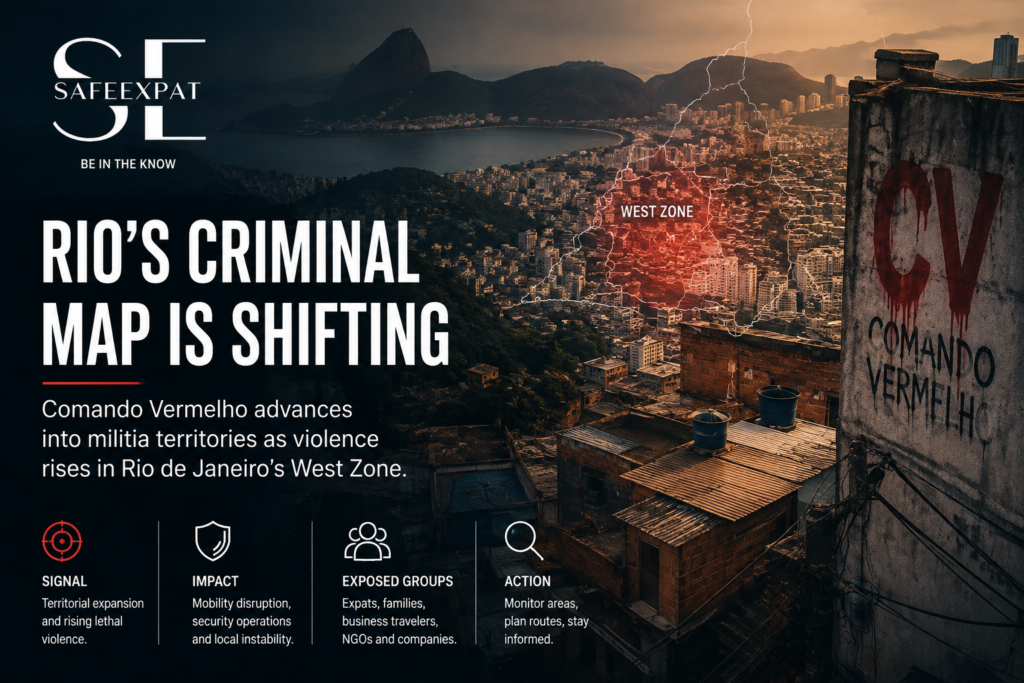
A territorial struggle between Comando Vermelho (CV) and militia-linked groups is reshaping parts of Rio de Janeiro’s criminal-security environment, particularly across sections of the West and Southwest Zones.
Data cited from Rio de Janeiro’s Public Security Institute indicate that violent deaths in the area covered by the 18th Military Police Battalion rose 61% in the first half of 2026, from 77 during the same period of 2025 to 124.
The trend is operationally important because territorial transitions between armed groups can produce periods of heightened unpredictability: shootings, road obstructions, police deployments, temporary closures and sudden changes in local movement conditions.
For expatriates, travelers and international organizations, the signal does not indicate that Rio as a whole is experiencing the same level of deterioration. Exposure remains highly localized. The principal requirement is therefore better geographic awareness, route monitoring and avoidance of active confrontation zones.
Signal
Comando Vermelho is continuing efforts to expand into areas of Rio de Janeiro historically influenced or controlled by militia organizations.
The current pattern is particularly visible around parts of Jacarepaguá and the wider West/Southwest Zone, where criminal groups are competing for territory and the economic activity attached to that territory.
Through June 2026, 124 violent deaths were recorded in the policing area that includes Jacarepaguá, Taquara, Praça Seca and Rio das Pedras, compared with 77 during the first six months of 2025. The measure includes intentional homicide, robbery resulting in death, bodily injury resulting in death and deaths resulting from state intervention.
The security response is also widening.
On 13 August 2026, Rio’s Military Police deployed 27 battalions, special-operation units and all eight regional policing commands in an operation explicitly aimed at limiting Comando Vermelho’s territorial expansion. Activity affected multiple locations across the capital, Baixada Fluminense and the metropolitan region.
A further development occurred on 18 August, when police reported killing Pierre Sá da Silva, known as “PQD,” during an operation in Gardênia Azul. Investigators described him as an important CV figure in Rio’s West Zone and alleged that he had been coordinating expansion toward several communities, including attempts to enter Rio das Pedras.
These developments suggest that the issue is no longer simply the presence of organized crime. The more important signal is a changing territorial balance accompanied by an active state effort to prevent further expansion.
Assessment
Understanding Comando Vermelho
Comando Vermelho — literally Red Command — is one of Brazil’s oldest and most powerful criminal organizations.
It emerged from Rio de Janeiro’s prison system during the 1970s before expanding into street-level criminal activity and becoming deeply embedded in the city’s drug-trafficking economy. Its activities today extend beyond narcotics into weapons trafficking, robbery, extortion and forms of control over economic activity and services inside territories where it maintains influence.
Its importance extends well beyond Rio.
Available assessments place the organization in numerous Brazilian states, with connections to trafficking routes extending into the Amazon and broader Latin American criminal networks. Reuters and other specialist assessments have described its membership as numbering in the tens of thousands.
The group’s territorial model is particularly important for understanding the current Rio signal.
Unlike criminal networks that can operate primarily through dispersed financial or trafficking structures, CV traditionally derives considerable influence from physical control of communities. Territorial dominance can provide access to drug markets, logistical corridors, local businesses and other revenue streams.
Why militia territory matters
Rio’s militias are themselves organized-crime structures, many historically involving serving or former security personnel. Over time, some developed extensive systems of territorial economic control, including extortion and illegal monopolies involving transport, property, communications and other services.
The distinction between drug faction and militia therefore does not imply a simple confrontation between criminals and community protectors.
Both types of organizations can impose coercive control over residents and commercial activity.
What is changing is who controls particular territories and revenue streams.
Research cited in a UK government assessment found that by 2023 Comando Vermelho accounted for approximately 51.9% of territory controlled by armed groups across Greater Rio, while militia-controlled territory had declined. That historical trajectory helps explain the current confrontations.
The present security environment therefore appears to reflect a continuing redistribution of criminal power rather than an entirely new phenomenon.
Why the transition period is important
For SafeExpat, the principal risk is not simply whether one criminal organization replaces another.
It is the transition itself.
Established criminal control can produce severe and unacceptable security conditions, but contested control tends to introduce an additional layer of volatility.
Territorial competition may involve:
- armed confrontations between rival groups;
- retaliatory violence;
- temporary road obstruction;
- police incursions and checkpoints;
- interruption of public transport or commercial activity;
- closure of schools or local services;
- sudden restrictions on movement imposed by armed actors;
- displacement of violence into neighboring communities.
Law-enforcement pressure can further increase short-term volatility even when its objective is to improve long-term security.
Rio authorities have been conducting Operation Containment, an extended campaign targeting Comando Vermelho’s financial, logistical and operational structures. The scale and persistence of these operations indicate that authorities regard CV’s territorial expansion as a significant security challenge.
There is also an international dimension.
Effective 5 June 2026, the United States formally designated Comando Vermelho as a Foreign Terrorist Organization and as a Specially Designated Global Terrorist entity.
For multinational organizations and financial institutions with U.S. exposure, this increases the importance of counterparty screening, third-party due diligence and awareness of indirect exposure to businesses operating in criminally controlled environments.
Exposed Groups
Residents and expatriates in affected West and Southwest Zone communities face the highest direct exposure, particularly where criminal control is actively contested.
International families and students may encounter sudden disruption to school transportation, local services or routine travel when security operations occur nearby.
Business travelers and foreign personnel can be exposed when drivers or navigation applications unintentionally route vehicles toward areas experiencing active security incidents.
NGOs and community organizations operating in peripheral districts may face temporary access restrictions, program interruptions and increased duty-of-care requirements.
Delivery, logistics and transport operators face elevated exposure where road access is disrupted or routes pass close to contested communities.
International companies and global mobility teams should consider both physical-security exposure and the compliance implications associated with interaction with businesses or intermediaries operating under coercive criminal control.
Travelers concentrated in Rio’s principal tourist districts are generally less directly exposed to the territorial confrontation itself, but transfers across the metropolitan area can create indirect exposure if routing is poorly planned.
Operational Impact
The most probable effect for internationally mobile populations is localized mobility disruption rather than city-wide paralysis.
Security operations can begin rapidly and change road conditions with limited warning. Armed confrontations may temporarily affect bus routes, local businesses, schools and access roads.
Vehicle movement deserves particular attention. A route considered normal one day may become unsuitable during a police operation or criminal confrontation.
Corporate transport providers may need to reroute employees at short notice.
Organizations with personnel visiting communities or industrial and commercial areas outside Rio’s central business and tourist districts should maintain stronger journey-management procedures than would normally be required for movement within the South Zone.
The broader economic impact may also become increasingly relevant.
Territorial criminal organizations can seek revenue from businesses, informal transport, utilities, telecommunications, property and other economic activity. Changes in control may therefore alter local extortion patterns or expose businesses to competing demands.
Likelihood
Elevated
Further localized security incidents are likely.
The increase in lethal violence, continuing territorial competition and repeated police operations indicate that the underlying drivers remain active.
The death of an alleged senior CV figure in the West Zone on 18 August may disrupt part of the organization’s local command structure, but it does not by itself remove the broader territorial competition.
This assessment does not imply an elevated probability of widespread violence across Rio de Janeiro as a whole.
The risk remains geographically concentrated.
Time Horizon
30 days
The next month is the most useful operational monitoring window.
Authorities are actively conducting operations against CV expansion while criminal organizations continue competing for strategically and economically valuable territory.
The interaction between these two dynamics creates potential for repeated but geographically limited disruption.
The longer-term struggle for territorial control is likely to extend beyond this period, but the 30-day horizon is the most relevant for travel, staffing and mobility decisions.
Recommended Actions
For residents and expatriates
Monitor neighborhood-level security conditions rather than relying only on city-wide crime assessments.
Avoid entering communities where police operations or armed confrontations are reported, even when navigation applications suggest the route as the fastest option.
Review alternative routes before travelling through Jacarepaguá and other areas experiencing recurring security activity.
If gunfire or a security operation begins nearby, remain inside a protected building where possible and move away from windows until conditions stabilize.
Do not approach, photograph or attempt to observe police operations, barricades or armed-group activity.
For travelers
Use established transport providers for airport transfers and cross-city journeys, particularly at night or when travelling to unfamiliar peripheral districts.
Confirm destinations with drivers rather than relying exclusively on automated routing.
Treat reports of shootings, road closures or police operations as route-planning information rather than assuming that an incident affects the entire city.
For companies and global mobility teams
Maintain neighborhood-level monitoring for personnel rather than using a single security rating for Rio de Janeiro.
Identify employees, contractors, accommodation and regular transport routes located near communities experiencing repeated armed incidents.
Ensure drivers have authority to abandon or reroute journeys without waiting for management approval when local conditions deteriorate.
Review security-provider and transportation contingency arrangements for staff operating regularly in the West Zone.
Organizations with U.S. legal or financial exposure should also ensure appropriate legal and compliance review where suppliers, counterparties or commercial activity may intersect with entities subject to U.S. terrorism-related restrictions following the June 2026 designation of Comando Vermelho.
Watch Indicators
SafeExpat assesses the following indicators as particularly important:
- further territorial confrontations involving CV and militia-linked groups in western Rio;
- expansion of recurring violence beyond currently contested communities;
- additional large-scale deployments under Operation Containment;
- temporary road or public-transport disruption associated with security operations;
- significant changes in violent-death and shooting data from Rio’s Public Security Institute and armed-violence monitoring organizations;
- reports that additional militia-controlled communities have shifted to CV influence;
- retaliatory violence following arrests or deaths of important criminal figures;
- changes to foreign-government travel or security advisories covering Rio;
- increased disruption affecting commercial districts, transport corridors or locations regularly used by foreign personnel.
Confidence Level
High
The central assessment is supported by multiple independent reporting streams, historical territorial-control research, current police activity and data attributed to Rio de Janeiro’s Public Security Institute.
Uncertainty remains over the exact boundaries of criminal territorial control. Such boundaries can change rapidly, and claims regarding control of individual communities are often difficult to independently verify in real time.
SafeExpat therefore treats neighborhood-level territorial attribution as dynamic rather than permanent.
SafeExpat Assessment
Rio de Janeiro is not facing a uniform deterioration in security. It is experiencing a localized but strategically important reconfiguration of criminal territorial control.
Comando Vermelho’s expansion into areas historically dominated by militias matters because contested territory produces greater uncertainty than established criminal boundaries. The resulting risk is not limited to direct criminal violence: police operations, road disruption, changes in local economic control and rapidly shifting mobility conditions can affect people with no connection to organized crime.
For expatriates and international organizations, the appropriate response is therefore not generalized avoidance of Rio.
It is precision awareness.
Know which parts of the city are changing, understand when movement conditions are deteriorating, maintain alternative routes and recognize that in Rio, security risk can change substantially within only a few kilometers.
SafeExpat assesses continued localized volatility in contested parts of western Rio as Elevated over the next 30 days, with the greatest operational exposure arising from unexpected movement through active confrontation or police-operation areas.