Editorial Product
SafeExpat DOSSIER
Executive Summary
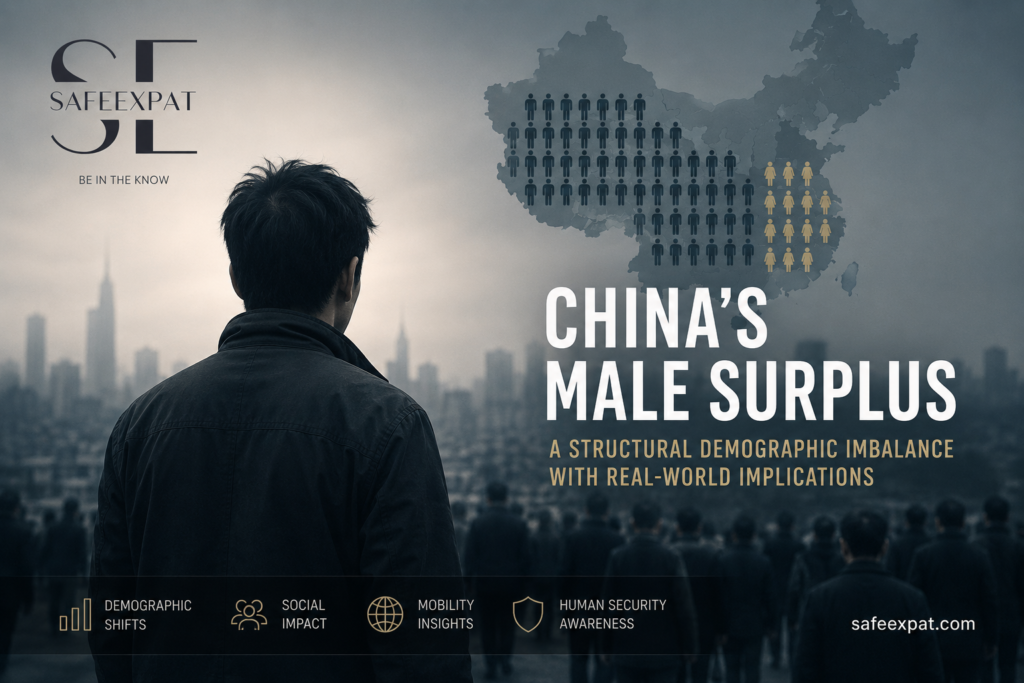
China continues to carry one of the world’s largest absolute gender imbalances. Official Chinese data for the end of 2025 recorded 716.85 million males and 688.04 million females — a difference of approximately 28.8 million people. A separate 2025 national population sample produced a similar gap of around 29 million.
The operational significance is not the headline number alone. The imbalance intersects with declining fertility, delayed marriage, internal migration, income inequality and changing expectations surrounding marriage and family formation.
The resulting “marriage squeeze” is unevenly distributed. Research indicates that lower-income men in rural communities and less economically advantaged areas can face considerably greater difficulty finding partners than urban, wealthier and more mobile men.
For SafeExpat audiences, this should be understood primarily as a long-term socioeconomic and human-security signal, rather than evidence of an immediate nationwide security threat.
Signal
China entered 2026 with approximately 28.8 million more men than women, according to official year-end population figures. Men represented around 51% of the population, compared with 49% for women.
The scale is significant, but the national number can be misleading if treated as though those 29 million people are all unmarried men competing for the same partners. Age distribution, mortality, migration, marriage preferences and regional differences substantially affect the actual marriage market.
What matters operationally is the concentration of disadvantage.
Academic research examining rural China has found that the marriage market is particularly difficult for men from rural backgrounds and less privileged socioeconomic groups, where income, housing, location and perceived ability to provide upward mobility can heavily influence marriage prospects.
The individual example provided — a man approaching 40 and living outside a major metropolitan centre with limited relationship prospects — therefore corresponds with a documented broader pattern, although SafeExpat cannot independently verify that specific individual case.
China’s gender imbalance should also not be attributed exclusively to the former one-child policy. Research identifies a combination of demographic policy, longstanding son preference, sex selection and socioeconomic structures as contributing factors.
Assessment
This is increasingly less a story about numerical demographics and more a question of geography, opportunity and social stratification.
China is highly urbanised: almost 68% of permanent residents were living in urban areas by the end of 2025, while more than 451 million people remained classified as rural residents. At the same time, China had approximately 301 million migrant workers, illustrating the scale at which younger working-age populations move between regions.
Migration can amplify local demographic distortions. Younger women with greater educational or employment opportunities may move toward stronger urban labour markets, leaving some poorer communities with a more difficult local marriage environment.
Research has consequently identified what demographers describe as a male marriage squeeze: not every excess male will remain unmarried, but some groups face systematically weaker prospects, particularly where lower income, limited mobility and rural residence combine.
This interacts with another major demographic transformation.
China’s population declined again in 2025. Births fell to 7.92 million, while deaths reached 11.31 million, producing a natural population decline of 3.39 million during the year. People aged 60 or above represented 23% of the population.
The male surplus therefore sits inside a broader demographic system characterised simultaneously by population contraction, ageing, declining fertility, changing marriage behaviour and geographic inequality.
That combination matters more than the male-female ratio in isolation.
Exposed Groups
The strongest direct exposure falls on unmarried Chinese men in lower-income rural communities and smaller cities where demographic, economic and geographic disadvantages overlap.
Indirectly exposed groups include foreign nationals entering cross-border relationships or marriage arrangements; women migrating into China through informal matchmaking channels; foreign NGOs and humanitarian organisations working on trafficking or vulnerable migration; international companies operating in lower-tier cities and remote industrial locations; diplomatic and consular personnel handling welfare or exploitation cases; researchers and international students working in rural communities; and global mobility teams responsible for employees and accompanying family members outside major metropolitan centres.
Foreign nationals living in Beijing, Shanghai, Shenzhen or other large international cities should not interpret the national male surplus as evidence that China generally presents an increased personal-security threat.
The demographic signal is considerably more nuanced and geographically uneven.
Operational Impact
For most expatriates and travellers, there is no immediate direct operational impact from the national gender imbalance.
The more relevant consequences are secondary.
In economically weaker communities, competition surrounding marriage can increase pressure on household finances, housing ownership and family savings. Research on rural marriage markets has documented the importance of economic status and the ability of potential husbands to provide social mobility.
A second area of concern involves cross-border marriage.
Trafficking and coercive marriage involving women from neighbouring Southeast Asian countries into China have previously been documented by international organisations. More recent reporting from Myanmar has also recorded trafficking cases involving women intended for marriages in China. This does not demonstrate that the demographic imbalance automatically creates trafficking, but it identifies a legitimate human-security channel requiring continued monitoring.
Foreign nationals should therefore distinguish between legitimate international relationships and commercial matchmaking arrangements involving brokers, unexplained payments, document retention or pressure to travel to isolated locations.
At the organisational level, the demographic imbalance can also contribute to different social environments between China’s highly international metropolitan centres and smaller rural or industrial communities. Companies relocating foreign personnel to lower-tier locations should therefore rely on localised assessments rather than national demographic averages.
Likelihood
Moderate
The underlying imbalance itself is highly likely to persist because demographic structures change slowly.
However, SafeExpat does not assess the gender imbalance alone as a likely trigger for sudden nationwide instability or widespread security deterioration.
The more probable scenario is continued, geographically uneven pressure affecting marriage markets, household economics, internal migration, social welfare requirements and specific forms of exploitation.
Claims that tens of millions of unmarried men inherently translate into increased violence or political instability should therefore be treated cautiously unless supported by stronger location-specific evidence.
Time Horizon
3–6 months
China’s underlying gender imbalance will remain essentially unchanged over this timeframe.
What can change more rapidly are the policy and operational consequences surrounding it: marriage incentives, fertility policies, rural social programmes, regulation of marriage-related payments, migration patterns and enforcement activity against trafficking or fraudulent matchmaking networks.
The deeper demographic effect extends well beyond six months and should be considered a multi-year structural issue.
Recommended Actions
- Global mobility teams: differentiate between major metropolitan China and lower-tier or rural assignments when assessing social environment, employee integration and accompanying-family requirements.
- Foreign companies operating outside major cities: incorporate demographic and socioeconomic factors into community-level assessments without assuming that male-heavy populations automatically represent higher security risk.
- Foreign nationals considering marriage or matchmaking arrangements: independently verify intermediaries, financial demands and legal documentation. Avoid surrendering passports or immigration documents to private brokers.
- Embassies and consular teams: maintain awareness of cross-border marriage fraud, coercion and trafficking patterns affecting nationals from neighbouring Asian countries.
- NGOs and international organisations: monitor marriage-related trafficking alongside labour exploitation and irregular migration rather than treating them as unrelated issues.
- Researchers and analysts: avoid using the headline “30 million men without wives.” The approximately 29-million figure represents the total national male-female population difference, not 29 million confirmed unmarried men.
Watch Indicators
SafeExpat will consider the signal more operationally significant if there is evidence of rising trafficking or forced-marriage cases along China’s borders; new national or provincial restrictions concerning bride prices or commercial matchmaking; significant changes in marriage-registration data; additional fertility or marriage incentives; unusual internal migration patterns involving younger women leaving economically weaker regions; increased documented fraud associated with international matchmaking; or credible research demonstrating measurable links between extreme local gender ratios and deterioration in community-level safety.
National demographic releases from the National Bureau of Statistics, Ministry of Civil Affairs data, provincial policy announcements, border enforcement activity and international trafficking reporting remain the strongest indicators to monitor.
Confidence Level
High
Confidence is high regarding the existence and approximate scale of the demographic imbalance. Official Chinese statistics place the male surplus at approximately 28.8–29 million people, closely supporting the widely cited figure of 30 million.
Confidence is also high that marriage-market pressure is disproportionately experienced by some poorer and rural male populations, supported by established demographic and sociological research.
Confidence is lower when predicting downstream effects such as crime, political instability or social disorder. Those relationships are substantially more complex, and the demographic imbalance should not be treated as a standalone predictor of insecurity.
SafeExpat Assessment
China’s male surplus is not an immediate crisis signal. It is a structural vulnerability embedded within a much larger demographic transformation.
The intelligence value lies not in the striking national figure, but in understanding where the imbalance concentrates and what other pressures overlap with it.
Rural disadvantage, internal migration, housing expectations, declining marriage rates, low fertility and population ageing increasingly interact within the same demographic system.
For expatriates and internationally mobile organisations, there is currently little justification for changing normal travel or security behaviour because of the gender imbalance itself.
The signal becomes more relevant at the local level — particularly in economically weaker communities and in cross-border environments where marriage migration, financial vulnerability and trafficking networks can intersect.
SafeExpat assesses this as a persistent socioeconomic and human-security indicator requiring monitoring, not an emerging nationwide security threat.