Editorial Product: SafeExpat WATCHING
Location: Tembagapura, Mimika Regency, Central Papua, Indonesia
Risk Domain: Security / Personnel Mobility / Extractive Industries
Monitoring Window: 7 days
Executive Summary
An armed attack on a PT Freeport Indonesia vehicle convoy near Tembagapura has introduced a renewed personnel-security signal around one of Indonesia’s most strategically important mining zones.
Gunfire struck two employee buses and a towing vehicle on 2 September 2026. Indonesian authorities reported no deaths or injuries. The West Papua National Liberation Army, or TPNPB, subsequently claimed responsibility and publicly called for mining activities in the area to stop.
The immediate exposure is concentrated around company transport, contractors, security-linked personnel and organizations operating along controlled mining corridors in Mimika. The incident does not currently indicate a generalized deterioration across Indonesia.
Signal
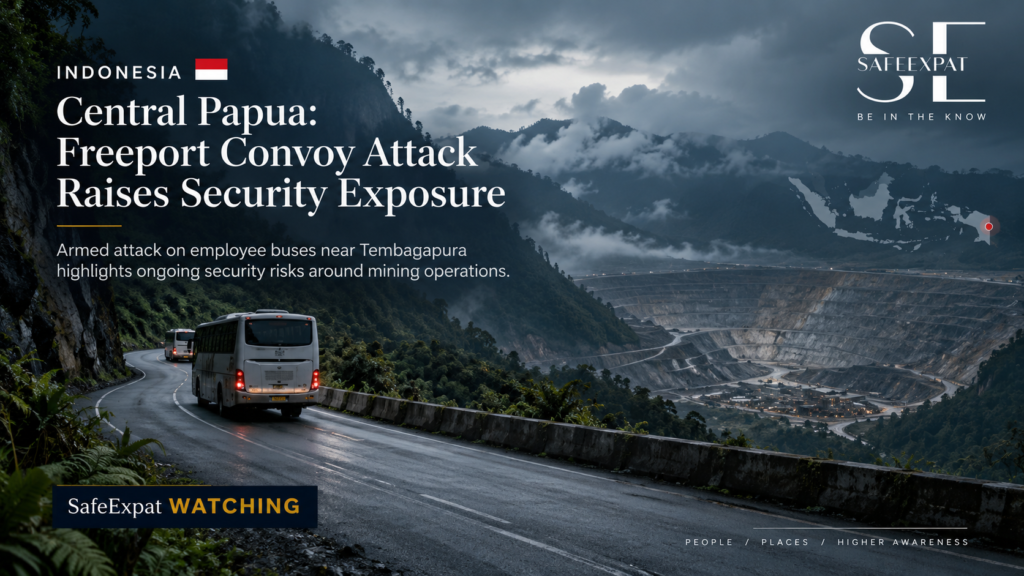
At approximately 08:25 local time on 2 September, a 15-vehicle PT Freeport Indonesia convoy was traveling from the Mile Point 68 area toward Timika when gunfire struck three vehicles near Mile Point 60 in Tembagapura District.
The convoy comprised 13 buses, one towing truck and one box truck. Two buses and the towing vehicle sustained damage. Indonesian police reported no fatalities or injuries and recovered evidence including spent 5.56mm cartridge cases during the subsequent investigation.
On 4 September, TPNPB spokesperson Sebby Sambom issued a statement claiming responsibility for the shooting. Reporting based on that statement also attributed to a TPNPB commander a demand for mining operations involving gold, copper and other natural resources in Tembagapura to cease.
There is an important verification distinction: Indonesian authorities confirmed the attack itself but had not publicly confirmed TPNPB responsibility at the time of the initial investigation. TPNPB’s attribution and accompanying statements therefore remain claims by the organization rather than independently established findings.
Assessment
The most important development is not the physical damage to the vehicles. It is the demonstrated ability and apparent intent to expose routine company personnel movements to armed attack along an established mining transport corridor.
This increases the security relevance of transport scheduling, convoy procedures and movement between Tembagapura and Timika for personnel associated with the mining sector.
The accompanying TPNPB statement also suggests that commercial and extractive activity itself may increasingly be framed as a legitimate target within the group’s political and military narrative.
Available reporting supports a threat directed toward Freeport operations, personnel and mining activity. It does not yet establish a verified blanket threat against every foreign company, investor or person involved in natural-resource activity across Papua.
The distinction matters operationally: current evidence supports heightened vigilance around the Mimika–Tembagapura mining environment rather than treating the incident as an Indonesia-wide threat.
Exposed Groups
The most directly exposed groups include:
- PT Freeport Indonesia employees and contractors moving between mining facilities and Timika.
- Foreign technical specialists, engineers, consultants and expatriate personnel assigned to Central Papua.
- Mining, logistics, construction and infrastructure contractors supporting operations around Tembagapura.
- Security personnel accompanying commercial movements.
- International organizations or NGOs operating in remote areas of Central Papua.
- Aviation and logistics personnel supporting isolated communities or industrial facilities.
- Global mobility and corporate-security teams responsible for personnel deployed to Mimika.
- Families of expatriate or rotational personnel whose travel depends on company-managed transport.
Exposure is substantially lower for travelers elsewhere in Indonesia unless their itinerary includes Central Papua or remote areas affected by the Papua conflict.
Operational Impact
The principal near-term impact is likely to be increased security controls rather than immediate interruption of mining production.
Organizations should anticipate the possibility of:
Personnel-movement restrictions. Company transport schedules, convoy procedures or road movements between Timika and operational areas may be modified at short notice.
Enhanced security presence. Indonesian authorities may strengthen security along mining corridors and around sensitive installations.
Transport delays. Additional checks, convoy consolidation or temporary movement restrictions could increase journey times for employees and contractors.
Contractor exposure. Personnel who are visibly associated with mining, logistics or infrastructure operations may face greater risk than ordinary urban travelers.
Reduced emergency flexibility. Any deterioration in road access can complicate medical evacuation, workforce rotation and movement between remote facilities and Timika.
Corporate duty-of-care pressure. Companies deploying foreign nationals may need to reassess movement approvals, journey-management procedures and insurance conditions.
No confirmed shutdown of PT Freeport Indonesia’s wider mining operations has been reported in connection with this incident.
Likelihood
Elevated
Further isolated security incidents affecting mining-related transport or security forces in Central Papua are credible.
The attack demonstrates both capability and intent against a recurring commercial movement pattern, while TPNPB’s subsequent claim reinforces the possibility that Freeport-linked activity will remain a symbolic and operational target.
However, current evidence does not demonstrate that a sustained campaign against all mining movements is underway.
Time Horizon
7 days
The immediate monitoring period should focus on whether the attack produces additional armed incidents, retaliatory security operations, transport restrictions or new TPNPB statements.
If no additional incidents emerge during this period, the event may remain a localized security episode within the longer-running Papua conflict.
Repeated attacks against company transport or infrastructure would materially change that assessment.
Recommended Actions
Organizations with personnel in Mimika or Tembagapura should review movement procedures rather than automatically suspend operations.
Confirm that staff travel uses formally approved company transport and that independent road movements into sensitive mining areas are avoided.
Global mobility and security teams should verify current journey-management procedures for movements between Timika, Tembagapura and remote operating sites, including communications coverage and escalation protocols.
Avoid publishing employee transport schedules, route information or workforce movement patterns on public channels.
Foreign personnel scheduled to deploy to Central Papua should receive a location-specific security briefing before travel rather than relying on general Indonesia guidance.
Organizations should also verify whether corporate insurance, medical evacuation and assistance providers impose restrictions on travel to Central Papua.
The U.S. State Department currently designates Central Papua as Level 4 — Do Not Travel, citing persistent localized conflict and previous kidnappings of foreign nationals.
Personnel already operating in the region should ensure that management knows their location and that contingency arrangements do not depend exclusively on unrestricted road access.
Watch Indicators
SafeExpat is monitoring for:
- further attacks on PT Freeport Indonesia vehicles or facilities;
- additional TPNPB statements identifying commercial or foreign personnel as targets;
- confirmation or rejection by Indonesian authorities of TPNPB responsibility;
- strengthened security deployments around Tembagapura;
- temporary restrictions on the Tembagapura–Timika transport corridor;
- changes to employee transport or workforce rotation procedures;
- attacks involving aviation serving remote Central Papua locations;
- Indonesian police or military operations following the incident;
- embassy or foreign-government security updates concerning Central Papua;
- evidence that threats are expanding beyond Freeport-linked operations to other extractive-sector companies.
The wider operating environment remains relevant. UK travel guidance describes regular armed clashes between TPNPB and Indonesian security forces in Central and Highland Papua and notes previous threats involving foreign nationals.
Confidence Level
Medium
Confidence is high regarding the occurrence, location and immediate consequences of the attack because these details have been confirmed by Indonesian police and corroborated by ANTARA.
Confidence is lower regarding attribution and the precise scope of future targeting. TPNPB has publicly claimed responsibility, but that claim had not been independently confirmed by investigators in the reporting reviewed.
Statements about future attacks should therefore be treated as indicators of intent rather than evidence that a broader operational campaign has already begun.
SafeExpat Assessment
The Mile Point 60 attack should be treated as a localized but meaningful change in the security environment surrounding strategic mining operations in Central Papua.
The operational signal is the combination of armed action against routine employee transportation and subsequent rhetoric directed at extractive activity. That combination increases exposure for personnel whose employment, transport or corporate identity connects them visibly to mining operations.
For most travelers and expatriates elsewhere in Indonesia, the incident does not materially alter the national risk picture. For companies and foreign personnel operating in Mimika and Tembagapura, however, routine transport should now be considered part of the security environment rather than a purely logistical function.
SafeExpat will be watching for evidence that isolated attacks are developing into a sustained pattern against commercial personnel, transport corridors or extractive infrastructure.