Editorial Product: SafeExpat WATCHING
Geographic Focus: Libya · Türkiye · Greece · Eastern Mediterranean
Assessment Date: 23 October 2026
Executive Summary
On 20 October 2026, Libya’s eastern-based House of Representatives unanimously approved the 2019 maritime delimitation agreement with Türkiye, reversing years of political opposition.
The decision strengthens Ankara’s position across Libya’s divided political landscape while renewing tensions with Greece, Egypt and the European Union over competing maritime claims.
The immediate implications are primarily diplomatic. However, the development could increase uncertainty surrounding offshore energy exploration, maritime jurisdiction and future commercial operations in contested areas.
Foreign companies, offshore operators, maritime personnel and international organisations with exposure to the Eastern Mediterranean should reassess their monitoring priorities.
Signal
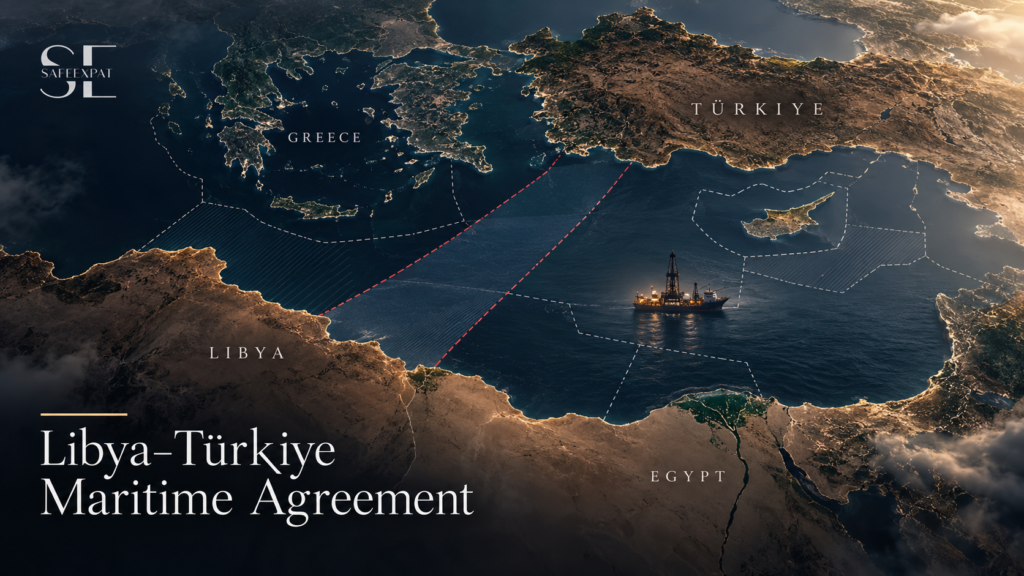
On 20 October 2026, the Libyan House of Representatives, meeting in Benghazi, approved the maritime memorandum originally signed between Ankara and Libya’s former Government of National Accord on 27 November 2019.
The parliament also repealed two decisions adopted in 2020: one rejecting the Turkish-Libyan agreements and another calling for the severance of political relations with Türkiye.
This constitutes a significant political reversal.
Previously, the maritime arrangement was supported by authorities in western Libya but rejected by the eastern parliament, historically aligned with military commander Khalifa Haftar.
The decision now removes an important source of domestic parliamentary opposition to the agreement.
Türkiye welcomed the vote, while Greece rejected it, maintaining that the memorandum disregards Greek maritime rights, including those associated with Crete and other islands.
The European Union reiterated on 21 October that the agreement cannot produce legal consequences for third states.
On 22 October, Greece and Egypt reaffirmed their opposition and discussed extending their existing maritime delimitation arrangements eastwards towards Cyprus.
These developments indicate that the parliamentary vote has already generated a coordinated diplomatic response.
Assessment
The principal significance lies in the changing political alignment around the agreement, rather than an immediate alteration of maritime operations.
Three developments deserve particular attention.
1. Türkiye’s expanding influence across Libya
Ankara originally supported the western Libyan authorities against eastern forces during the country’s civil conflict.
The eastern parliament’s approval suggests an important shift towards broader institutional acceptance of Turkish-Libyan maritime cooperation.
This may improve Türkiye’s ability to engage with political and economic actors across Libya, although the country’s institutional fragmentation remains unresolved.
2. Renewed competition over offshore resources
The maritime agreement establishes overlapping claims to jurisdiction in parts of the Eastern Mediterranean.
These areas are strategically relevant to hydrocarbon exploration, maritime economic rights and potential energy infrastructure development.
The vote may encourage additional diplomatic initiatives, exploration proposals or cooperation between Turkish and Libyan institutions.
However, parliamentary approval does not itself authorise new drilling operations or establish uncontested rights in disputed waters.
3. A more complex regional operating environment
Greece, Egypt and Cyprus contest the agreement’s implications for their maritime claims.
The EU has reiterated that it considers the memorandum incompatible with the law of the sea and without legal effect for third states. Türkiye maintains that the agreement is lawful and equitable.
The resulting disagreement creates a persistent source of legal and geopolitical uncertainty.
For international operators, the critical question is whether these competing positions begin to produce operational restrictions, overlapping authorisations or increased maritime deployments.
Exposed Groups
Primary exposure
- Offshore energy companies, exploration contractors and technical survey operators working in the Eastern Mediterranean.
- Maritime transport companies, vessel operators and specialist marine insurers.
- International investors evaluating energy infrastructure or offshore concessions.
- Foreign personnel and commercial organisations engaged in Libyan-Turkish projects.
- Legal, compliance and security teams responsible for operations in disputed maritime areas.
Secondary exposure
- Expatriates and international professionals employed in the maritime and energy sectors.
- Diplomatic missions and international organisations monitoring regional stability.
- Business travellers and foreign contractors moving between Libya, Türkiye, Greece and neighbouring countries.
- Global mobility teams responsible for staff assignments and maritime-related travel.
For ordinary residents and tourists, the current development does not independently establish a new immediate safety threat.
Operational Impact
Maritime operations
Competing maritime claims may complicate the planning of offshore surveys, research missions or commercial activities if new operational measures are introduced.
Energy investment
Companies could face uncertainty regarding exploration licences, jurisdictional claims and the political acceptability of proposed projects.
Diplomatic relations
Further exchanges between Ankara, Athens, Cairo, Brussels and Libyan authorities could complicate regional cooperation.
Corporate compliance
Operators working in potentially disputed areas may require additional legal assessment before accepting authorisations or contracts.
Travel and mobility
No direct change to civilian entry requirements, commercial aviation or ordinary passenger travel has been established as a consequence of the parliamentary vote.
Any future disruption would require separate, verifiable developments.
Likelihood
Moderate — Further Operational Disruption
Continued diplomatic disagreement is highly likely, given the immediate responses from Greece, Egypt and the EU.
However, escalation from diplomatic confrontation into tangible maritime disruption is less certain.
Operational risk would rise if governments announce overlapping offshore activities, deploy additional maritime assets or introduce restrictions affecting commercial operations.
At present, the evidence supports heightened monitoring rather than assumptions of imminent confrontation.
Time Horizon
30 Days
The coming month is relevant for evaluating whether the parliamentary decision leads to additional political, legal or operational measures.
Particular attention should be given to Turkish-Libyan institutional cooperation, Greek-Egyptian diplomatic initiatives, potential maritime survey announcements and notices affecting offshore activities.
Longer-term implications for energy exploration and investment may develop over the following three to six months.
Recommended Actions
For offshore and maritime operators
- Review planned activities against current maritime jurisdiction claims and officially issued operational notices.
- Monitor maritime safety communications, including relevant NAVTEX notices and navigational warnings.
- Verify whether proposed offshore activities fall within areas subject to competing claims.
- Maintain contingency procedures for survey postponements, vessel diversions or administrative disputes.
For international companies and investors
- Conduct jurisdiction-specific legal and regulatory reviews before entering new offshore commitments.
- Evaluate contractual exposure to delays caused by political or licensing disputes.
- Maintain contact with local legal advisers and relevant commercial authorities.
- Establish internal escalation thresholds linked to official operational developments, rather than political statements alone.
For expatriates, travellers and global mobility teams
- Maintain normal travel planning unless official advisories or transport arrangements change.
- Identify personnel whose assignments involve offshore operations or maritime infrastructure.
- Review company-specific security arrangements for crews and technical contractors operating near disputed areas.
- Monitor relevant embassy communications and official transport notices.
Watch Indicators
SafeExpat will prioritise developments capable of changing the operational risk picture:
- Turkish-Libyan cooperation: New agreements, implementing measures or joint maritime initiatives.
- Offshore exploration: Announcements of seismic surveys, drilling licences or new concession activity in disputed areas.
- Greek-Egyptian coordination: Progress towards extending maritime delimitation arrangements.
- European Union response: Additional diplomatic measures or formal positions affecting regional cooperation.
- Maritime activity: Relevant NAVTEX notices, survey-vessel movements or military deployments linked to the dispute.
- Legal developments: New United Nations correspondence, international legal proceedings or formal maritime claims.
- Commercial consequences: Verified interruptions, suspensions or changes to offshore operations.
An increase in diplomatic rhetoric alone should not automatically be classified as an immediate operational threat.
Confidence Level
High — Verified Political Development
The parliamentary approval, reversal of the 2020 decisions and international diplomatic responses are supported by official Libyan, Turkish, Greek and European Union statements.
Confidence is high regarding the existence and political significance of the development.
The probability, timing and geographic extent of any future operational consequences remain less certain because they depend on decisions not yet taken or implemented.
SafeExpat Assessment
The strategic signal is a change in political alignment, not an immediate maritime crisis.
Libya’s eastern parliamentary approval reduces a significant domestic obstacle to Turkish-Libyan cooperation while reinforcing an existing dispute over maritime jurisdiction in the Eastern Mediterranean.
The decision may strengthen Türkiye’s regional negotiating position, but it does not resolve competing claims or remove the legal objections maintained by Greece, Egypt and the European Union.
For internationally mobile people and organisations, the immediate priority is not travel avoidance. It is identifying whether diplomatic developments begin to affect maritime activity, offshore investment, regulatory certainty or personnel operations.
SafeExpat will treat a transition from political alignment to concrete maritime activity as the principal indicator of rising operational risk.
SafeExpat — Intelligence, not news.