Boko Haram’s Evolution: Why the Lake Chad Insurgency Remains a Regional Security Threat
From a local movement to a fragmented regional insurgency — what enduring militant capabilities mean for civilian safety, humanitarian access and international operations.
Executive Summary
Boko Haram’s transformation from a radical religious movement into a sustained insurgency demonstrates how local grievances, state failures, armed recruitment and transnational extremist networks can create enduring security threats.
Although military operations have weakened the original organization, its successor and rival factions remain active across northeastern Nigeria and the Lake Chad Basin.
Renewed militant activity in 2026 presents continuing risks to civilian mobility, humanitarian operations, infrastructure and regional stability.
For expatriates, international organizations and businesses, the principal concern is not the historical strength of Boko Haram but the persistence and geographic concentration of its operational capabilities.
Signal
The Boko Haram insurgency has evolved rather than disappeared.
The movement emerged in the early 2000s under Mohammed Yusuf, whose preaching attracted followers in northeastern Nigeria, particularly around Maiduguri.
A decisive turning point occurred in July 2009, when Yusuf was killed in police custody following a violent confrontation between his movement and Nigerian security forces.
Under Abubakar Shekau, the organization developed into an armed insurgency employing bombings, kidnappings, attacks on security installations and violence against civilian communities.
In March 2015, Shekau pledged allegiance to the Islamic State. Internal disagreements subsequently produced a major split in 2016, creating two distinct organizations:
JAS — Boko Haram
Jama’atu Ahlis Sunna Lidda’awati wal-Jihad, commonly identified as Boko Haram, has been associated with attacks against civilian communities, abductions and coercive control.
ISWAP
Islamic State West Africa Province, an Islamic State affiliate, has developed a more structured organization, concentrating significant operational effort on military installations, territorial influence and resource acquisition.
Shekau died in 2021 during fighting involving ISWAP, but his death did not end the insurgency.
The threat remains current. During October 2026, Nigerian forces reported repelling renewed militant attacks against military positions in Borno and Yobe states.
On 12 November 2026, the Institute for Security Studies published research identifying financial incentives linked to captured military equipment as an additional factor supporting ISWAP’s operational sustainability.
These developments indicate that the conflict is no longer adequately understood through the actions of a single organization or leader.
Assessment
How did a relatively small movement become a regional security threat?
Boko Haram’s expansion cannot be explained by religious ideology alone. Its development reflects the interaction of several structural and operational factors.
01 — Weak governance and declining institutional trust
In parts of northeastern Nigeria, limited public services, economic exclusion, corruption and distrust of state institutions created conditions that extremist recruiters could exploit. The violent suppression of the movement in 2009, including Yusuf’s extrajudicial killing, contributed to its subsequent radicalization and militarization.
This does not make insurgent violence inevitable. It illustrates how excessive state responses can reinforce extremist narratives and undermine public confidence.
02 — Recruitment through local vulnerabilities
Prolonged unemployment, disrupted education, displacement and insecurity have contributed to the vulnerability of some communities. Recruitment has involved a combination of ideological commitment, economic incentives, coercion and abduction.
The motivations of individual recruits differ considerably. Treating the movement as exclusively ideological risks overlooking the social and economic conditions that enable its regeneration.
03 — Geography and cross-border mobility
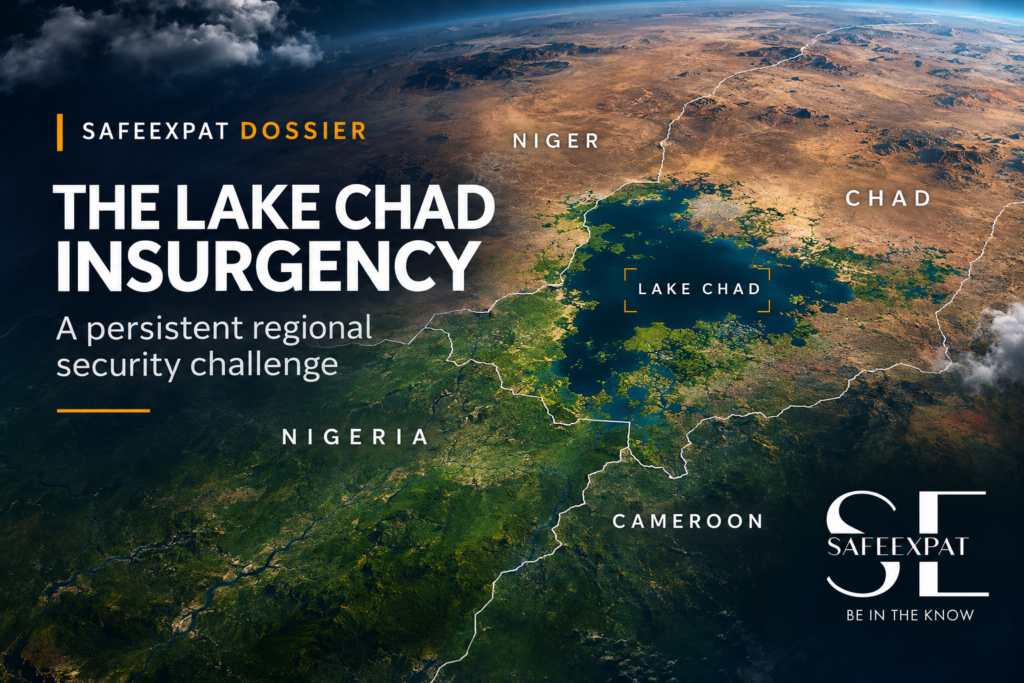
The Lake Chad Basin provides an operating environment characterized by islands, waterways, remote settlements and international borders. Militant organizations have exploited this environment to maintain dispersed operating areas and move between Nigeria, Cameroon, Chad and Niger.
The resulting security challenge cannot be addressed through national military operations alone.
04 — Adaptation of organizational structures
Rather than remaining dependent on one centralized command, the insurgency fragmented into competing organizations capable of recruiting, financing and sustaining their activities independently.
The rivalry between JAS and ISWAP has produced significant militant casualties but has not eliminated either organization’s capacity to threaten civilians or security forces.
05 — Economic incentives and resource acquisition
Insurgent financing extends beyond ideological sponsorship. Extortion, exploitation of local economic activities, theft and the capture of military equipment have supported different factions.
Research published by the Institute for Security Studies in November 2026 indicates that ISWAP uses financial rewards associated with captured military equipment to motivate fighters.
This suggests that some attacks on military positions serve several objectives simultaneously: weakening government forces, replenishing equipment and sustaining recruitment.
Analytical finding: Boko Haram’s endurance results from its ability to adapt to political, economic and military pressure while exploiting persistent local vulnerabilities.
Exposed Groups
The level of exposure varies significantly by location, activity and organizational profile.
Highest exposure
- Residents and internally displaced people in conflict-affected communities of Borno, Yobe and parts of Adamawa.
- Humanitarian personnel operating near contested areas or along vulnerable supply routes.
- Local transport operators, traders, agricultural workers and contractors.
- Security personnel and civilians living near military installations.
- Communities in Cameroon’s Far North, Niger’s Diffa region and Chad’s Lac Province.
Additional exposure
- International NGOs and development organizations relying on local partners.
- Journalists and researchers working in northeastern Nigeria.
- Foreign employees involved in infrastructure, logistics or development projects.
- Families, students and aid-dependent communities affected by service closures or displacement.
- Global mobility teams responsible for personnel movements and duty-of-care arrangements.
Geographic distinction: Exposure should not be generalized uniformly across Nigeria. Conditions in Lagos, Abuja and other major cities differ considerably from those in the northeastern conflict zone, although separate security threats exist elsewhere in the country.
Operational Impact
Mobility and transport
Armed attacks, unauthorized checkpoints, military operations and road restrictions can interrupt movement between towns and prevent access to remote communities.
Civilian safety
Bombings, abductions, armed raids and fighting near populated areas create risks for residents and personnel operating in affected locations.
Humanitarian access
Insecurity can delay the delivery of food, medicines and essential supplies, while restricting access to displaced communities.
Business continuity
Organizations may experience interrupted supply chains, higher operating costs, project suspensions, staff relocation requirements and reduced access to local partners.
Education and essential services
Schools, healthcare facilities and public infrastructure may face disruption from insecurity, displacement or restrictions on movement.
Regional spillover
Militant movement and military operations around Lake Chad can affect border communities and complicate cross-border logistics and humanitarian planning.
Operational concern: Deteriorating local security conditions may develop faster than organizations can adjust their movement and continuity arrangements.
Likelihood
This rating does not imply an equally high probability of attacks throughout Nigeria. The timing, location and scale of individual incidents remain uncertain.
Time Horizon
The broader insurgency remains a structural security challenge extending well beyond this monitoring period.
Recommended Actions
For expatriates and international travelers
- Avoid travel to conflict-affected northeastern states where official government advisories recommend against travel. The UK Foreign, Commonwealth & Development Office advises against all travel to Borno, Yobe, Adamawa and Gombe; verify the current regional guidance before making decisions.
- Review national travel advisories before any journey involving northern Nigeria or the Lake Chad region.
- Do not assume that major roads, daylight travel or the presence of security forces makes movement safe.
- If already present in an affected area, coordinate decisions with established local security contacts, your employer and relevant consular authorities.
For NGOs and international organizations
- Review staff locations, exposure to remote operating areas and security arrangements of local implementing partners.
- Revalidate movement approvals, communication arrangements and emergency relocation plans.
- Establish explicit conditions under which field movements or activities should be suspended.
- Consider remote coordination where physical presence is not essential.
- Confirm that medical referral, evacuation and personnel-accountability procedures remain practical under current conditions.
For businesses and global mobility teams
- Map exposure at city, district and transport-route level rather than relying solely on national risk ratings.
- Identify dependencies on transport corridors, suppliers and infrastructure near conflict-affected areas.
- Maintain alternative communication and supply arrangements for critical activities.
- Review insurance conditions, contractual obligations and duty-of-care responsibilities before deployments.
- Include local employees and contractors in continuity and security planning.
For families and educational institutions
- Verify school operating arrangements and emergency communication procedures in affected areas.
- Maintain accessible emergency contacts and essential personal documentation.
- Avoid non-essential movement near reported security incidents or during security operations.
- Follow verified local instructions rather than unconfirmed social media reports.
Watch Indicators
SafeExpat identifies the following indicators as particularly relevant to changes in operational exposure:
- Militant activity: More frequent coordinated attacks against military positions or civilian settlements in Borno and Yobe.
- Geographic expansion: Confirmed attacks in areas previously experiencing lower levels of insurgent activity.
- Factional developments: Significant leadership changes, defections or renewed fighting between JAS and ISWAP.
- Transport disruption: Road closures, security checkpoints, route-specific attacks or access restrictions affecting Maiduguri and surrounding areas.
- Cross-border developments: Increased militant activity or restrictions affecting Cameroon’s Far North, Niger’s Diffa region and Chad’s Lac Province.
- Humanitarian access: Suspension of field operations, displacement increases or interruptions to essential aid delivery.
- Official security posture: Changes in embassy advisories, curfews, military communications or regional security coordination.
Multiple indicators occurring simultaneously may signal a deterioration broader than an isolated security incident.
Confidence Level
Armed groups operate in environments where independent verification is difficult. Some operational claims originate from military authorities or individuals formerly associated with militant organizations.
Principal sources
- International Crisis Group — JAS vs. ISWAP: The War of the Boko Haram Splinters (March 2024).
- ACLED — Jihadist Groups Pose a Growing and Expanding Threat in Africa (2026).
- Reuters — Nigeria Says Troops Kill 48 Islamist Fighters After Attacks in Borno, Yobe Bases (30 October 2026).
- Institute for Security Studies — Islamic State Is Incentivising ISWAP to Target Military Stockpiles (12 November 2026).
- UK FCDO — Nigeria: Regional Risks and Travel Advice (live official guidance; check for updates).
SafeExpat Assessment
Boko Haram’s history demonstrates that the elimination of leaders and the recapture of territory do not necessarily eliminate an insurgency’s underlying capacity to regenerate.
The present threat is sustained by organizational fragmentation, local vulnerabilities, financing mechanisms and an operating environment that crosses national borders.
For internationally mobile people and organizations, the relevant intelligence question is not whether Boko Haram can destabilize Nigeria as a whole, but where its evolving capabilities intersect with personnel, transport routes and essential services.
Effective preparedness depends on understanding these intersections before a localized security incident becomes an operational disruption.