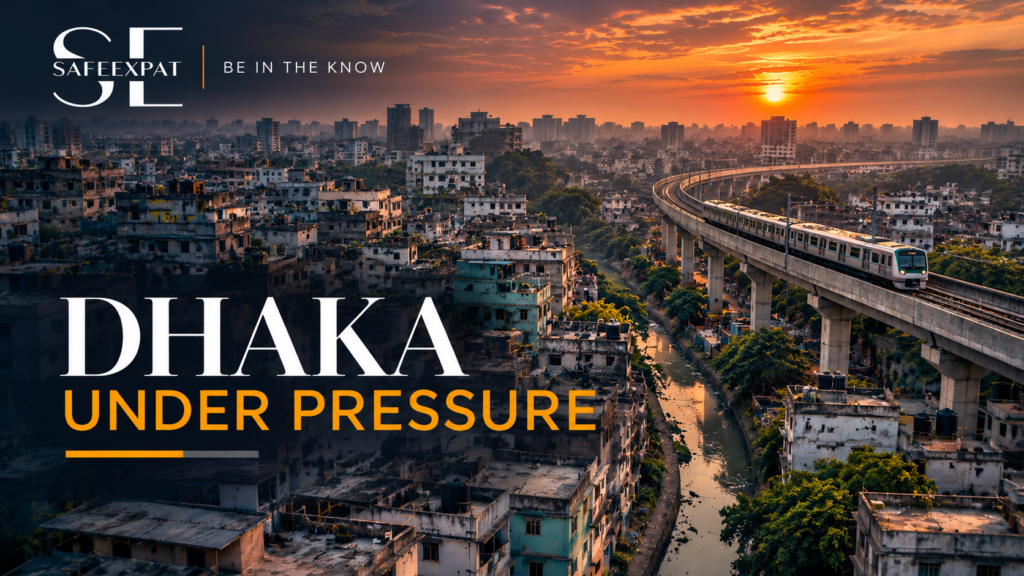
Dhaka is expanding faster than essential urban systems can consistently accommodate. For international residents and organizations, the question is not density alone, but whether housing, transport and essential services can withstand daily demand and disruption.
Executive summary
Dhaka’s extraordinary concentration of people and economic activity is placing long-term pressure on housing, roads, drainage, wastewater management and public health. The World Bank approved a $370 million sanitation and water-resilience program in February 2026, underscoring the scale of the infrastructure deficit. For expatriates, relocation firms, international schools and employers, the operational priority is to assess conditions at the specific building, neighbourhood and route level—not to treat the entire city as uniformly exposed. Infrastructure improvements offer a meaningful response, but funding approval is not the same as completed service delivery. [1]
The signal: growth outpacing capacity
Dhaka is among the world’s most densely populated urban centres, although precise density figures vary considerably depending on whether the measure covers the city corporations, built-up area or wider metropolitan region. A World Bank assessment published in 2022 cited an estimated 29,000 people per square kilometre, while a 2018 World Bank analysis described approximately 44,000 per square kilometre using a different geographic frame. These figures should not be treated as directly interchangeable. [2] [3]
The frequently repeated estimate of 300,000–400,000 migrants arriving annually comes from older World Bank documentation, including a 2015 project appraisal. It is useful historical context, not a verified 2026 migration count. [4]
The more consequential signal is the persistent gap between development and urban-service capacity. In February 2026, the World Bank reported that only around 20% of residents had piped sewer connections and another 2% used functional faecal-sludge management. It also reported that more than 80% of untreated wastewater and sewage was discharged into interconnected waterways. These figures describe systemic conditions rather than the water quality of any particular residence. [1]
Assessment: why density becomes an operational issue
High population density is not inherently a crisis. Dense cities can support efficient transit, concentrated services and productive economic activity. Exposure increases when development, drainage, waste collection, road capacity and emergency access fail to keep pace with demand.
Housing and building resilience
Residential selection requires more than a neighbourhood reputation or a modern-looking apartment. Building maintenance, fire exits, backup power, water storage, drainage and access for emergency vehicles may vary substantially from property to property. Historic World Bank resilience assessments identified construction oversight and emergency-response capacity as areas of concern. Those assessments establish a structural planning issue, not the safety status of any individual building today. [4]
Transport and time reliability
Road congestion can translate into uncertain commutes, missed appointments, delayed logistics and more difficult emergency movements. Rail investment provides an alternative along served corridors, but the existence of a metro line does not establish that a particular home, school or workplace has reliable end-to-end access. Employers should evaluate complete journeys, including the first and last kilometre.
Sanitation, flooding and health
Wastewater pollution, clogged canals and drainage constraints can interact during heavy rainfall. The World Bank’s 2026 program explicitly links sanitation improvement with water security and river restoration. This supports a structural concern about environmental exposure, but does not establish a current citywide disease outbreak or a specific active flood event. [1]
Who is exposed?
- Expatriates and international families: households with long school or workplace commutes, uncertain building maintenance, or limited alternative water and transport arrangements.
- Relocation providers: teams choosing properties and coordinating arrivals, school placements, transport and medical access.
- International schools: operators dependent on predictable student transport, drainage, utilities, staff attendance and parent communications.
- Employers and NGOs: organizations whose operations require staff movement, deliveries, reliable facilities and continuity during localized disruption.
Exposure is not uniform: individual buildings and transport corridors may have substantially different conditions, and newer infrastructure can reduce some constraints.
Operational impact and outlook
Assessed outcome: recurring neighbourhood-level disruption to commuting or essential services affecting Dhaka-based households and organizations.
Likelihood: Elevated over the next 3–6 months, as a qualitative SafeExpat judgment based on documented infrastructure deficits. This is not a prediction of a particular incident.
Impact: Variable by site and season; potentially significant for routes or premises without redundancy.
Confidence: Medium. The underlying infrastructure pressures are well documented, but current neighbourhood-level reliability data were not established for this assessment.
Dhaka’s growth also reflects economic opportunity. A World Bank urban-development announcement in 2024 linked urbanization to manufacturing employment and described investments intended to strengthen secondary cities and reduce pressure on the capital. These measures could improve conditions over time, but the benefits will depend on implementation and geographic coverage. [5]
Recommended actions
- Before signing a lease: ask for evidence of fire safety arrangements, recent maintenance, backup electricity, water supply, drainage performance and emergency vehicle access; verify directly where feasible.
- Before selecting a school or office: test the actual journey at normal peak hours and identify a second route or workable remote alternative.
- For international-school leadership: map bus-route pinch points, define rainfall-related transport decision thresholds and establish a parent-notification process.
- For employers and relocation teams: review commute resilience, medical access and continuity arrangements for each assigned property rather than relying on a single citywide risk label.
- Before heavy-rain periods: check official local weather warnings, drainage conditions and operator notices; adjust travel only when the relevant route or facility is affected.
Watch indicators
- Drainage and rainfall: Bangladesh Meteorological Department warnings and municipal notices indicating heavy rainfall or waterlogging on relevant routes.
- Water and sanitation: Dhaka WASA service notices and implementation updates on wastewater and water-resilience works.
- Transport: official metro operator announcements and verified road closures affecting specific commuting corridors.
- Infrastructure delivery: documented commissioning of sanitation, drainage or transport improvements; verified service gains would weaken the longer-term exposure assessment.
SafeExpat assessment
Dhaka’s principal mobility challenge is not population density in isolation. It is the uneven reliability of the systems that support a highly concentrated city. International organizations should prioritize property-level due diligence, route resilience and practical contingency arrangements. The most important development to monitor is whether announced infrastructure investment produces measurable, locally relevant improvements in service delivery.
Sources
- World Bank, World Bank Helps Reduce Dhaka’s Water Pollution, 10 February 2026.
- World Bank, Bangladesh urban development project document, 2022.
- World Bank, Toward a Livable Dhaka, 20 November 2018.
- World Bank, Bangladesh Urban Resilience Project: Project Information Document, 28 January 2015.
- World Bank, Bangladesh Receives $900 Million World Bank Financing, 21 June 2024.
This dossier assesses structural urban exposure, not a real-time incident. Site-specific conditions and current transport notices require local verification before operational decisions.