Editorial Product
SafeExpat DOSSIER
Executive Summary
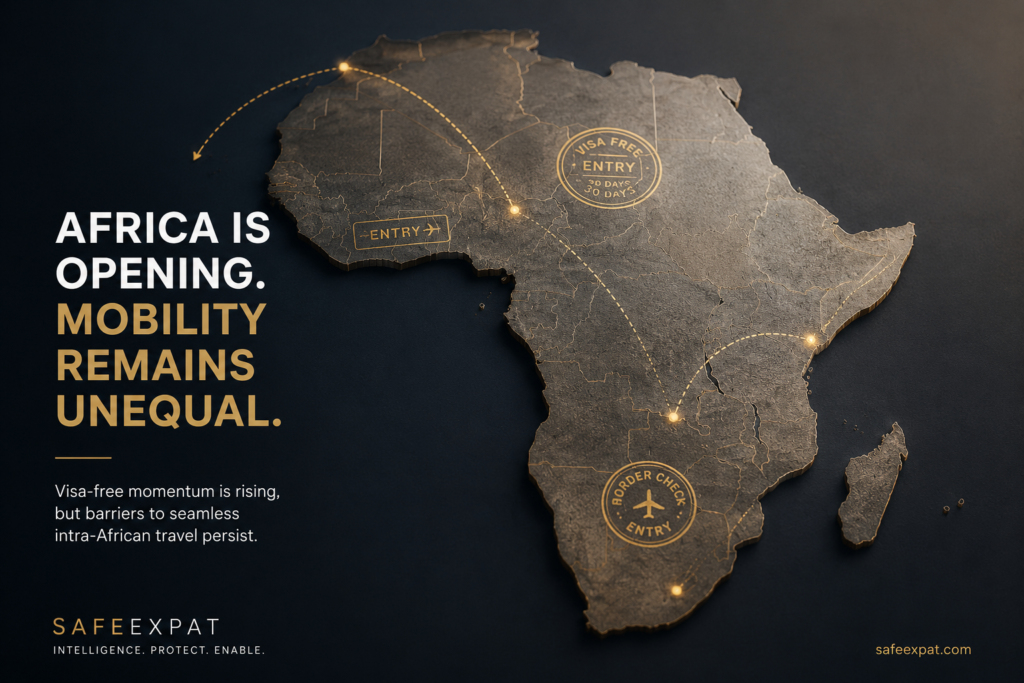
Togo’s decision to exempt African nationals from entry visas adds momentum to the continent’s gradual shift toward freer movement.
The operational signal is positive, but uneven: visa-free entry does not automatically mean friction-free travel, lower airfares, reliable direct routes or the right to work, reside or trade.
African passport holders, business travelers, students, NGOs, regional investors and global mobility teams remain exposed to inconsistent border practices, costly routing and fragmented policy implementation.
The issue matters because the African Continental Free Trade Area depends not only on moving goods and capital, but also on moving people predictably across borders.
Signal
Togo announced visa-free entry for nationals of African states holding valid passports in May 2026, with the measure framed as part of the country’s African integration policy.
The subsequent regulatory framework confirmed short-stay visa exemption for up to 30 days, while maintaining immigration checks, security discretion and a required pre-arrival travel declaration on the government platform.
This is a meaningful political and operational signal. It places Togo within a small but growing group of African states using visa policy to support continental mobility. However, the change also highlights a wider gap: many Africans still face visa requirements, e-visa processes, high travel costs, limited direct routes and uncertain border-level implementation.
The Africa Visa Openness Index reported that, in 2025, African citizens did not need a visa in only 28% of country-to-country travel scenarios within Africa, although that was an improvement from 20% in 2016.
Assessment
Togo’s move is strategically positive but operationally limited.
For expats, regional professionals and organizations operating across Africa, the key issue is not whether one country has opened its border. The key issue is whether mobility rules across the continent are becoming predictable enough to support work travel, regional assignments, study, NGO operations, family movement and cross-border business development.
The AfCFTA is designed to create a single market for goods and services, facilitated by movement of persons. Yet the AU Free Movement Protocol remains under-ratified: Mali, Niger, Rwanda and São Tomé and Príncipe have ratified it, while 15 ratifications are required for entry into force.
This creates a two-speed mobility environment. Some countries are opening entry channels. Others retain restrictive visa systems or complex administrative processes. Regional Economic Communities may offer corridors of easier movement, but these do not always translate into continent-wide predictability.
Air connectivity remains a separate constraint. Recent research on intra-African air routes found that structural and regulatory barriers continue to limit connectivity, with airline networks often shaped by home-market protection and limited cross-border competition.
For SafeExpat audiences, the main assessment is clear: Africa is moving toward greater openness, but operational mobility risk remains material.
Exposed Groups
African passport holders travelling outside their immediate regional bloc are the most directly affected.
Business travelers, entrepreneurs and investors may still face delays when attending meetings, conferences, site visits or trade events across multiple African jurisdictions.
Remote workers and digital professionals may misread visa-free entry as permission to work, stay longer or provide services locally.
Students, researchers, artists and sports professionals remain exposed to denied boarding, transit complications and inconsistent documentation checks.
NGOs, development organizations and humanitarian actors may face planning uncertainty where field teams move across several borders or rely on short-notice deployments.
Global mobility, HR and security teams supporting African staff should avoid assuming that a headline visa waiver automatically reduces all travel risk.
Families and diaspora travelers may benefit from easier entry into specific countries, but remain exposed to airline documentation checks, onward-ticket requirements and non-African transit visa rules.
Operational Impact
The most likely impact is not acute disruption, but uneven access.
Travelers may save time and cost where visa requirements are removed, especially for short visits to Togo. However, they may still need to complete pre-arrival declarations, show valid travel documents, prove itinerary details and satisfy standard immigration checks.
Organizations should expect continued itinerary complexity for multi-country travel. A traveler may enter one country visa-free but require an e-visa, visa on arrival or embassy-issued visa for the next destination.
Flight routing may remain expensive and indirect, especially where there are no direct intra-African services or where travelers must transit through Europe, the Gulf or another third-country hub. Reports on intra-African travel continue to document cases of costly, circuitous routing and boarding friction.
For businesses, the risk is missed meetings, delayed deployments, higher travel budgets and inconsistent employee experience.
For individuals, the risk is denied boarding, unexpected fees, overstay exposure, confusion between visa-free tourism and work authorization, or being refused entry despite a broadly permissive policy.
Likelihood
Elevated.
Further visa-opening announcements are likely over the coming months as African governments seek to align mobility policy with integration, trade and tourism goals.
However, the likelihood of continued friction is also elevated. Visa-free entry remains uneven, the AU Free Movement Protocol is not yet in force, and air connectivity constraints cannot be resolved through visa policy alone.
The more realistic scenario is gradual improvement with persistent operational gaps.
Time Horizon
3–6 months.
This timeframe matters because the practical effect of Togo’s policy and similar measures will become clearer through border implementation, airline document checks, business travel patterns, and whether additional African states announce comparable reforms.
It is also the relevant planning window for organizations arranging conferences, regional deployments, academic travel, NGO missions and market-entry visits.
Recommended Actions
African travelers should verify country-specific entry rules before every trip, even where a visa-free policy has been announced.
For travel to Togo, eligible African nationals should complete any required pre-arrival declaration, carry a valid passport or recognized travel document, and retain the travel slip or confirmation required at border control.
Do not treat visa-free entry as permission to work, reside, study or conduct regulated business activity. Short-stay entry rules and work authorization rules remain separate.
Build extra time into itineraries involving multiple African borders, especially where separate visa regimes, e-visas or land-border crossings are involved.
Check transit requirements carefully when routes pass through Europe, the Gulf, North Africa or other third-country hubs. A visa-free destination does not remove transit-document risk.
Organizations should maintain a live travel matrix for African passport holders by nationality, destination, purpose of travel, length of stay and route.
Global mobility teams should brief travelers on the difference between visa exemption, e-visa, visa on arrival, residence rights and work authorization.
Event organizers should issue invitation letters early and provide clear entry guidance by nationality, not only by destination.
Security and HR teams should monitor border practice, not just policy announcements. The operational test is whether airlines and immigration officers apply the rule consistently.
Watch Indicators
Official immigration updates from Togo and other African governments.
Changes to pre-arrival declaration systems, e-visa platforms or travel authorization requirements.
Additional African states announcing visa-free access for African nationals.
Ratification movement on the AU Free Movement Protocol.
AfCFTA announcements linking trade facilitation with movement of persons.
Airline route expansions, new direct intra-African services or changes in regional fare patterns.
Reports of denied boarding despite visa-free eligibility.
Embassy advisories and consular guidance on entry requirements.
Regional Economic Community updates on freedom-of-movement implementation.
Border-level reports from business travelers, NGOs, students and diaspora networks.
Confidence Level
Medium.
The policy signal is well supported by official and specialist visa-policy reporting. The broader assessment is also supported by the Africa Visa Openness Index, AU documentation and aviation connectivity research.
Confidence is moderated by implementation uncertainty. Border practice, airline enforcement, digital declaration systems and reciprocity may vary by nationality, route and port of entry.
SafeExpat Assessment
Togo’s visa-free move is a positive integration signal, but it should be read as part of a fragmented transition rather than a completed mobility shift.
Africa’s travel environment is opening selectively, not uniformly. For globally mobile Africans and organizations operating across the continent, the practical risk is no longer only whether a visa is required. It is whether the full travel chain — documentation, routing, transit, border discretion and purpose-of-stay rules — is predictable enough to support reliable movement.
SafeExpat assesses that intra-African mobility will continue to improve incrementally, but operational planning should remain conservative until policy alignment, air connectivity and border implementation become more consistent.