Editorial Product
SafeExpat DOSSIER
Executive Summary
A cross-border investigation has identified a previously obscured network of European investments linked to China’s State Administration of Foreign Exchange, the public authority responsible for managing the country’s foreign-exchange reserves.
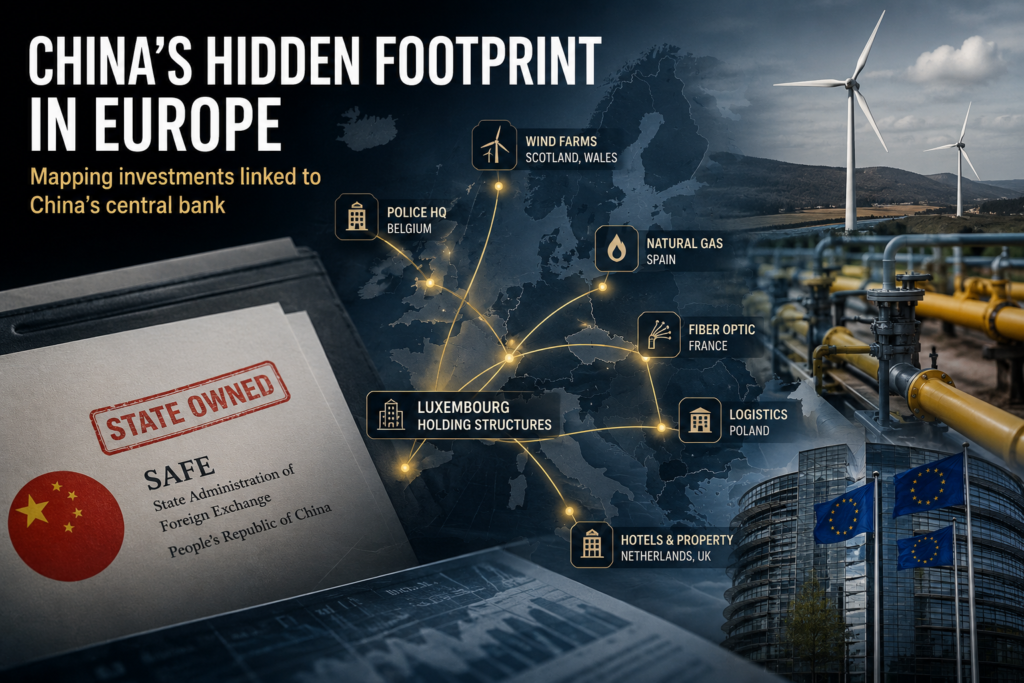
The holdings extend across energy, telecommunications, logistics, transport and strategically located real estate, including assets connected to natural-gas distribution, wind generation, fibre-optic infrastructure and buildings occupied by European public institutions.
The immediate concern is not evidence of operational interference. It is the difficulty faced by regulators, companies and the public in determining who ultimately owns or influences assets supporting essential European services.
The findings increase regulatory, compliance and reputational exposure for infrastructure operators, investors, government tenants and international organizations working with complex cross-border ownership structures.
Signal
An investigation coordinated by the Organized Crime and Corruption Reporting Project and European media partners has mapped a network of investments associated with China’s State Administration of Foreign Exchange, or SAFE.
Reporters combined information from European corporate and land registries with company filings in Luxembourg, the United Kingdom and offshore jurisdictions. They identified 28 Luxembourg-registered companies linked to SAFE that had acquired interests in European assets over approximately 14 years.
Many of the Luxembourg entities were ultimately connected to companies registered in the British Virgin Islands, where publicly accessible information about final government ownership was limited. Most had not previously been publicly associated with SAFE.
The identified holdings include:
- A 33.75% indirect interest in a company controlling Madrileña Red de Gas, a major natural-gas distributor serving households and businesses in the Madrid region.
- A 49% indirect interest in three large onshore wind farms in Wales and the Scottish Highlands.
- A minority holding in a French fibre-optic infrastructure company involved in rural connectivity and data-centre operations.
- Interests in Belgian companies owning buildings used by the European Commission and the Belgian Federal Police.
- Property and land interests connected to logistics centres in Poland.
- Commercial property, university accommodation and a minority holding in an Isle of Wight ferry operator in the United Kingdom.
- Hotel and residential property interests in central Amsterdam.
SAFE’s official responsibilities include operating and managing China’s state foreign-exchange reserves, gold reserves and other foreign-exchange assets. It also performs functions assigned by China’s State Council and the People’s Bank of China.
Assessment
The investigation reveals a transparency and governance vulnerability rather than an immediate infrastructure emergency.
Foreign state investment is not inherently hostile, and layered corporate vehicles are widely used by international investors for tax, financing and asset-management purposes. The reporting does not itself demonstrate illegal conduct, covert access to operational systems, political interference or preparations to disrupt European services.
The strategic issue is that ordinary corporate and property records did not provide a clear, consolidated view of the ultimate state-linked investor.
This matters because fragmented ownership information can prevent public authorities, commercial partners and critical-infrastructure operators from accurately assessing concentration, dependency and foreign-government exposure.
Minority ownership does not necessarily provide operational control. Nevertheless, the risk profile can change when several apparently unrelated holdings are viewed as components of a larger state-managed investment portfolio.
The exposure is especially relevant where an ownership chain intersects with:
- Energy distribution or generation.
- Digital and telecommunications infrastructure.
- Transport services.
- Logistics networks.
- Government-occupied buildings.
- Properties located close to sensitive institutions.
- Companies processing public-sector or strategically important data.
The findings also arrive as the European Union strengthens its approach to foreign-investment screening. On 19 May 2026, the European Parliament approved revised rules requiring member states to screen investments in designated sensitive sectors and allowing scrutiny of intra-EU transactions where the ultimate investor is controlled from outside the EU.
The investigation could therefore accelerate retrospective ownership reviews, expanded due diligence and political pressure for greater transparency around existing assets—not only future acquisitions.
Exposed Groups
The groups most directly exposed are:
Critical-infrastructure operators whose shareholders, landlords, lenders or investment partners may be connected to foreign state entities through complex structures.
European government agencies and public institutions occupying buildings with indirect foreign-government-linked ownership.
International companies and investors involved in acquisitions, financing, joint ventures or property transactions connected to the identified corporate network.
Global mobility and corporate-security teams responsible for assessing the resilience of utilities, telecommunications, transport and accommodation supporting internationally mobile personnel.
Compliance, legal and procurement teams that may need to reassess beneficial ownership, foreign-control indicators and contractual disclosure requirements.
NGOs, diplomatic missions and foreign personnel using infrastructure or facilities where ownership transparency may become politically or operationally sensitive.
Expatriates and internationally mobile families are unlikely to experience immediate direct consequences, but may face secondary exposure if regulatory action affects utilities, transport services, property management or infrastructure investment.
Operational Impact
No immediate interruption to energy, telecommunications, transport or public services has been reported as a result of the investigation.
The more credible operational consequences are regulatory and commercial.
Enhanced ownership reviews
Authorities and corporate partners may request additional documentation identifying ultimate shareholders, state affiliations, voting rights and control arrangements.
Transaction delays
Acquisitions, refinancing, asset transfers and infrastructure partnerships involving connected entities could face longer approval processes or additional national-security screening.
Contract and procurement reassessment
Government bodies and critical entities may examine leases, service agreements, data-processing relationships and procurement contracts involving companies with opaque ownership chains.
Financing and insurance exposure
Banks, insurers and institutional investors may adjust risk assessments where beneficial ownership cannot be established quickly or where a foreign state connection was previously undisclosed.
Reputational pressure
Companies may face questions from regulators, employees, tenants, local communities and commercial partners about whether they understood the identity of their ultimate investors.
Possible restructuring or divestment
Where authorities identify an unacceptable security or public-order risk, mitigation measures could include governance restrictions, information-access controls, asset separation or divestment. Such outcomes remain speculative and would require formal regulatory findings.
Resilience-planning implications
Organizations dependent on affected infrastructure should treat ownership transparency as one component of continuity planning. A change in regulatory status, financing access or corporate governance could disrupt an asset even without a physical security incident.
Likelihood
Elevated
Further political, regulatory and media scrutiny is likely because the findings concern state-linked investment in sectors already identified by European institutions as strategically sensitive.
However, the likelihood of immediate service disruption remains lower. The investigation establishes ownership links and opacity; it does not establish hostile operational control or an imminent threat to infrastructure.
The most probable near-term escalation is therefore administrative: ownership reviews, parliamentary questions, due-diligence requests and potential screening by national authorities.
Time Horizon
3–6 months
This period is most relevant for assessing whether the investigation produces formal regulatory action, national-security reviews, corporate disclosures or changes to investment structures.
Some institutions may begin internal reviews within days, but decisions involving ownership restrictions, governance conditions or divestment would normally require a longer legal and administrative process.
Organizations should also monitor how member states implement the EU’s strengthened foreign-investment screening framework.
Recommended Actions
Map indirect dependencies.
Organizations should identify the owners, landlords, infrastructure providers and investment vehicles supporting essential operations—not only their immediate contractual counterparties.
Verify ultimate ownership.
Due diligence should extend beyond the first European holding company and include offshore parents, nominee arrangements, state affiliations, voting rights and management-control provisions.
Separate ownership from operational access.
Determine whether an investor has board representation, privileged information rights, physical access, access to operational technology or influence over cybersecurity and data-management decisions.
Review critical contracts.
Check change-of-control, disclosure, audit, termination and national-security clauses in leases, infrastructure agreements, supplier contracts and joint ventures.
Assess continuity alternatives.
Global mobility and security teams should identify alternative telecommunications, transport, accommodation and utility arrangements for particularly sensitive locations or operations.
Coordinate compliance and security functions.
Corporate security, legal, procurement, finance and data-protection teams should share ownership findings rather than conducting isolated assessments.
Avoid nationality-based assumptions.
Risk assessments should focus on transparency, governance, access and dependency—not simply the nationality of an investor.
Prepare stakeholder communication.
Organizations connected to affected structures should be ready to explain what is owned, who exercises control and what safeguards protect operations and data.
Watch Indicators
Monitor:
- Announcements from European and national foreign-investment screening authorities.
- Parliamentary inquiries concerning Chinese state-linked ownership of European infrastructure.
- New beneficial-ownership disclosures from Luxembourg or British Virgin Islands entities.
- Changes in directors, shareholders or registered addresses within the identified corporate network.
- Reviews involving energy, telecommunications, transport or government-property assets.
- Requests for divestment, governance restrictions or limitations on access to sensitive information.
- Statements from the European Commission, national intelligence services and infrastructure regulators.
- Credit-rating, financing or insurance changes affecting companies linked to the holdings.
- Additional investigations identifying assets or jurisdictions not included in the initial mapping.
- Evidence distinguishing passive financial investment from operational influence.
The EU has already adopted a more harmonized anti-money-laundering framework containing clearer provisions on beneficial ownership and multi-layered control structures. Implementation and enforcement will be important indicators of whether authorities can close the visibility gaps highlighted by this investigation.
Confidence Level
High
The central ownership findings are supported by a coordinated investigation using corporate registries, land records, annual reports and company filings across multiple European jurisdictions.
Confidence is high that the identified structures and holdings warrant further examination.
Confidence is lower regarding their eventual security or operational consequences. Publicly available evidence does not establish that SAFE’s investments have been used to interfere with infrastructure operations, access sensitive systems or create deliberate service dependencies.
SafeExpat Assessment
The principal risk revealed by this investigation is not foreign investment itself. It is the absence of a reliable, publicly visible picture of who ultimately stands behind strategically relevant European assets.
For internationally active organizations, ownership transparency should now be treated as part of operational resilience—not only as a financial-compliance exercise.
A minority stake hidden behind several corporate layers may carry no immediate operational threat. But when ownership cannot be established quickly, authorities and companies lose time precisely when geopolitical conditions require faster decisions.
SafeExpat assesses that the investigation will primarily increase regulatory and reputational pressure over the coming months. The signal becomes operationally significant where opaque ownership is combined with governance influence, privileged information access or dependence on a service for which no practical alternative exists.