Editorial Product: SafeExpat WATCHING
Assessment date: 7 September 2026
Executive Summary
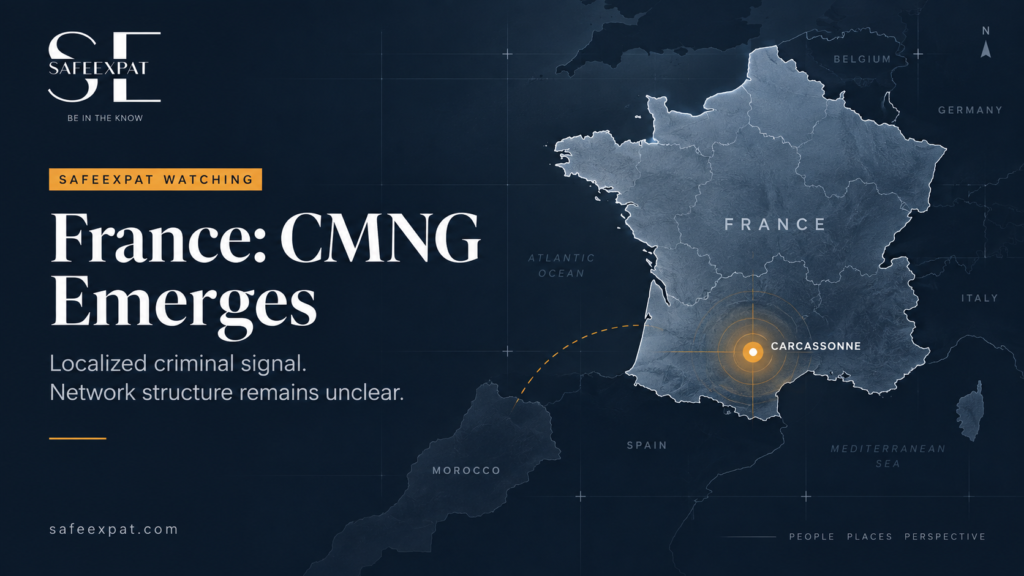
The self-styled “Cartel Mocro Nouvelle Génération” (CMNG) has emerged in France as a new criminal label associated with armed narcotrafic-related imagery and at least one serious violent incident.
The acronym appeared alongside “DZNG” in material linked to the 16–17 July 2026 shooting in Carcassonne, where one person was killed and four others were wounded. French reporting indicates investigators have not yet established whether CMNG represents a structured organization, an alliance, a local crew or simply a criminal brand.
Fresh open-source material circulating in early September suggests the CMNG name remains active online, with armed individuals again presented under the label. The material is not independently verified and should therefore be treated as an indicator of continued criminal signalling rather than confirmation of organizational expansion.
For expatriates, travelers and internationally mobile personnel in France, the immediate risk remains localized rather than generalized, with the highest potential exposure around narcotics distribution areas and locations affected by criminal territorial disputes.
Signal
CMNG first gained significant public attention following the shooting in the Fleming district of Carcassonne during the night of 16–17 July.
Five people were struck by gunfire. One died and four were injured. Police recovered 56 cartridge cases in 7.62 mm calibre, while a vehicle believed connected to the shooters was subsequently found burned. A video associated with the attack circulated online bearing the labels “DZNG” and “CMNG”.
Subsequent French reporting emphasized that investigators could not yet determine precisely what stood behind the CMNG designation. Le Monde reported that material posted under the CMNG name did not establish a clear organizational relationship with the established Marseille-based DZ Mafia network, leaving open possibilities ranging from cooperation to imitation or appropriation of an established criminal brand.
The signal has nevertheless persisted.
In early September, an independent weapons-monitoring source circulated additional imagery and video attributed to people claiming CMNG affiliation and displaying firearms. This material provides evidence that the CMNG identity continues to be used publicly, but its provenance, location and genuine organizational affiliation have not been independently confirmed.
The intelligence significance is therefore not that France has definitively acquired a new nationwide “cartel”, but that a new violent criminal brand appears to be attempting to establish visibility, credibility and deterrence through social-media propaganda and weapons displays.
Assessment
CMNG should presently be understood as a developing criminal-network indicator rather than a fully mapped organization.
The combination of a lethal incident, deliberate dissemination of attack imagery, continued weapons displays and cartel-inspired branding suggests an effort to create reputation and psychological influence beyond the immediate physical violence.
This matters because modern French narcotrafic organizations increasingly use recognizable labels, social-media communication and decentralized local partnerships. Criminal branding can allow relatively small groups to amplify their perceived reach or operate under the reputation of larger networks.
French reporting has similarly noted that established criminal labels can be used beyond their original geographic base without investigators immediately being able to determine whether the individuals involved are formal members, affiliates, subcontractors or imitators.
For SafeExpat audiences, the principal concern is spillover exposure rather than deliberate targeting of foreign nationals.
There is currently no credible evidence that CMNG is specifically targeting expatriates, tourists or foreigners because of nationality.
The word “Mocro” or Moroccan imagery used in criminal branding should also not be interpreted as indicating broader involvement by Moroccan nationals or communities. The relevant intelligence indicator is the specific criminal network or individuals using the label, not ethnicity or nationality.
Exposed Groups
Potentially exposed groups include:
- Residents living close to established narcotics distribution points or recurrent gang-conflict locations.
- Expatriate families whose homes, schools or regular routes pass through affected neighborhoods.
- Travelers using hotels, restaurants or transport routes close to temporary police operations or crime scenes.
- International students living in lower-cost residential districts close to drug-market activity.
- Delivery personnel, ride-hailing drivers and mobile workers operating late at night.
- Foreign-owned businesses located near contested commercial or residential areas.
- Corporate security and global mobility teams responsible for personnel in cities experiencing narcotrafic-related violence.
- NGOs, journalists and researchers working directly on organized crime or vulnerable neighborhoods.
Operational Impact
The most likely impact on globally mobile populations is short-notice localized disruption.
A violent narcotrafic incident can rapidly result in police cordons, road closures, emergency-service activity, restricted access to residential buildings or temporary disruption around schools, businesses and transport routes.
The greater concern is the unpredictability of targeted shootings. Individuals with no connection to criminal networks can become exposed simply through proximity to a confrontation.
Continued armed propaganda could also precede retaliatory violence between competing groups, although there is presently insufficient evidence to attribute such a cycle specifically to CMNG.
The broader impact could include increased police deployments and enforcement activity in locations where authorities identify attempts to seize or control drug-distribution territory.
There is currently no evidence supporting a France-wide change in personal-security posture for expatriates or travelers solely because of CMNG.
Likelihood
Moderate
Further online signalling under the CMNG label is plausible, and the July Carcassonne incident demonstrates that the label has appeared in connection with genuine lethal violence.
However, the underlying organization remains insufficiently defined. Available evidence does not yet establish the number of members, leadership structure, territorial reach, operational autonomy or durability of the network.
The probability of localized additional criminal activity is therefore meaningful, while the probability of a geographically broad CMNG-driven security deterioration cannot presently be assessed as elevated.
Time Horizon
30 days
The next several weeks should help determine whether CMNG represents a temporary criminal branding exercise or the beginning of a more persistent network.
Repeated claims associated with independently confirmed incidents, arrests involving common actors, or appearances of the same label in multiple cities would significantly strengthen the assessment that CMNG has moved beyond localized criminal signalling.
Conversely, an absence of verified operational activity despite continued social-media imagery would support the possibility that the label’s perceived strength exceeds its actual organizational capacity.
Recommended Actions
Individuals living or working in France do not need to alter routine activity nationwide because of this development.
Those living close to areas experiencing recurrent narcotrafic violence should maintain greater situational awareness, particularly during evening and nighttime hours.
Avoid remaining near known drug-distribution points, even when they appear inactive. Criminal confrontations can develop with little warning.
If gunfire or a major police deployment occurs nearby, remain inside a secure building where possible and avoid windows, balconies and street-facing areas until authorities have secured the location.
Do not approach crime scenes to film or observe events. Police cordons associated with organized-crime incidents may expand rapidly.
Expatriate families should identify an alternative route between home, schools and workplaces when their normal route crosses an area experiencing repeated shootings or major police operations.
Companies with personnel in affected cities should monitor incidents at neighborhood level rather than relying exclusively on national risk assessments. A city may remain operationally normal while a small number of streets experience significantly higher exposure.
Corporate security teams should map employee residences, frequently used transport hubs and offices against recurrent serious-crime locations when credible evidence of territorial conflict emerges.
Watch Indicators
SafeExpat will monitor for:
- French police, prosecutor or Interior Ministry statements explicitly identifying CMNG.
- Arrests in which authorities establish membership, leadership or operational links to the group.
- Additional shootings carrying independently verified CMNG claims.
- CMNG branding appearing in multiple French cities.
- Confirmed operational links between CMNG and DZNG or other established narcotrafic networks.
- Evidence of territorial competition over drug-distribution points.
- Weapons seizures connected through forensic or investigative evidence to previous CMNG-linked incidents.
- Retaliatory attacks following claimed CMNG operations.
- Increased specialist police deployments in affected neighborhoods.
- Changes from weapons-display propaganda to explicit operational threats followed by real-world incidents.
Social-media material alone should remain a secondary indicator unless corroborated by police investigations, judicial reporting or independently verifiable events.
Confidence Level
Medium
Confidence is high regarding the Carcassonne shooting itself and the appearance of CMNG/DZNG branding in material connected with the incident. The casualty figures and investigation are supported by established French reporting.
Confidence is lower regarding CMNG’s organizational identity, territorial reach and relationship with other criminal groups. French investigators and major media reporting have explicitly highlighted uncertainty surrounding the meaning and authenticity of the emerging labels.
Recent September weapons imagery is useful as an OSINT monitoring signal but remains insufficiently independently corroborated to establish operational capability or geographic expansion.
SafeExpat Assessment
CMNG currently represents an emerging criminal-network signal rather than a confirmed nationwide cartel.
Its significance lies in the combination of real-world lethal violence, deliberate criminal branding and continued armed communication.
For international residents and organizations in France, this does not indicate a generalized deterioration in security. The relevant risk is more specific: increasingly mobile and heavily armed narcotrafic networks can generate sudden, highly localized security environments in otherwise normally functioning cities.
The critical intelligence question is therefore not whether CMNG’s online image is credible, but whether investigators begin identifying repeat personnel, territorial presence, command relationships and additional independently confirmed operations behind the label.
Until those indicators emerge, SafeExpat assesses CMNG as a WATCHING-level development requiring continued verification rather than escalation of general travel or expatriate security posture.