Editorial Product
SafeExpat WATCHING
Executive Summary
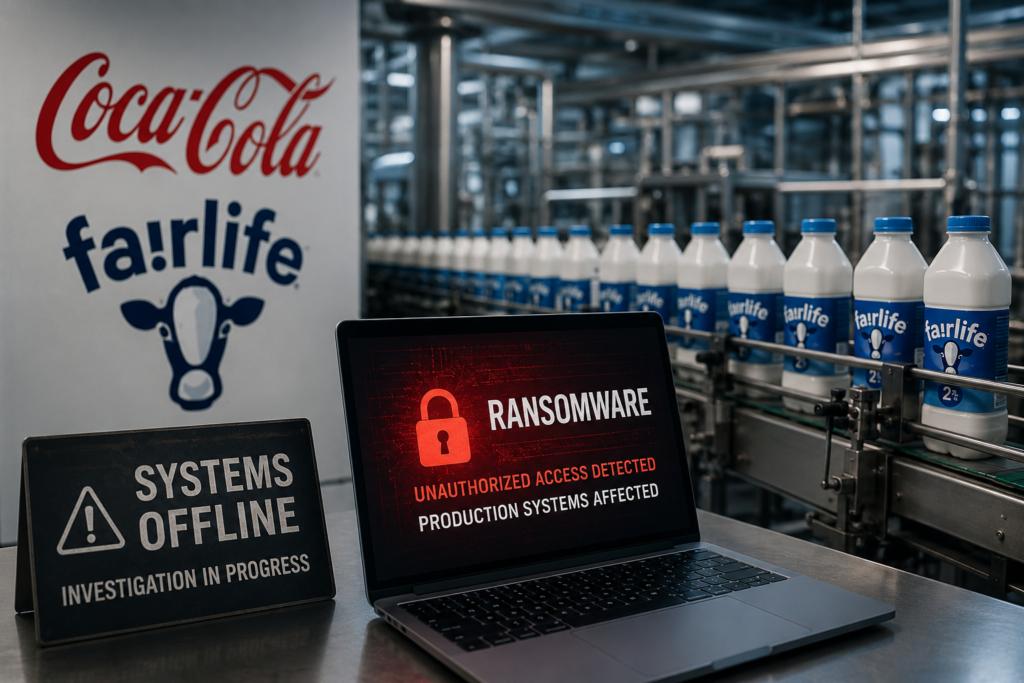
Coca-Cola has disclosed that fairlife, its dairy subsidiary, identified unauthorized third-party access to part of its systems, including production-related systems, in connection with a ransomware event.
The incident has led to a temporary suspension of fairlife production operations in the United States, while Canadian production is currently not affected.
For globally mobile organizations, the event is a cyber-to-operations signal: ransomware is increasingly capable of disrupting manufacturing, logistics and supplier reliability even when product safety is not directly impacted.
The immediate exposure is concentrated around supply continuity, vendor dependency, business continuity planning and operational technology resilience.
Signal
Coca-Cola announced on 16 July 2026 that fairlife, LLC identified unauthorized access by a third party to a portion of its systems, including systems connected to production operations. The company linked the incident to a ransomware event.
After detecting the issue, Coca-Cola said it activated incident response and business continuity protocols, engaged outside advisors and cybersecurity experts, and notified law enforcement. The company stated that the full scope, nature and impact of the incident remain under investigation.
Product quality and safety have not been impacted, according to the company. However, production operations at fairlife in the United States are temporarily suspended while affected systems and operations are restored.
Assessment
This incident matters because it shows how cyber intrusion into production-related environments can create immediate physical-world disruption.
For SafeExpat audiences, the relevance is not limited to Coca-Cola or fairlife products. The case reflects a wider operational pattern: ransomware actors increasingly target systems that support manufacturing, logistics, distribution and supplier continuity. When those systems are interrupted, the consequences can extend beyond IT teams into procurement, travel planning, facility staffing, retail availability and commercial delivery obligations.
The company’s statement that product safety has not been affected reduces immediate consumer health concern. However, the temporary suspension of U.S. production indicates that operational restoration, not only forensic investigation, is now the key risk variable.
Exposed Groups
The most exposed groups include:
Food and beverage supply chain partners dependent on fairlife production flows.
Retailers, distributors and cold-chain logistics providers managing U.S. dairy inventory.
Corporate procurement teams relying on affected product lines for institutional, hospitality or retail operations.
Business continuity teams monitoring supplier disruption and cyber-linked production delays.
Foreign staff, contractors or service providers assigned to affected production or logistics sites.
Investors and risk managers tracking operational resilience across major consumer goods companies.
Global mobility teams supporting personnel whose work depends on stable facility access, supplier scheduling or logistics coordination.
Operational Impact
The confirmed operational impact is the temporary suspension of fairlife production operations in the United States. Canadian production operations are currently not impacted.
Practical downstream effects may include:
Short-term delivery delays for fairlife products in U.S. distribution channels.
Inventory tightening if restoration takes longer than expected.
Schedule changes for logistics, maintenance, production support or vendor personnel.
Increased cybersecurity verification demands across connected suppliers and service providers.
Possible contractual, procurement or reputational exposure if supply commitments are affected.
At this stage, the incident should be treated as an operational continuity issue rather than a food safety issue, based on the company’s current disclosure.
Likelihood
Moderate
Further operational disruption is possible because production has already been suspended and the full scope of the incident remains under investigation. However, Coca-Cola has activated response protocols, engaged external cybersecurity support and stated that product quality and safety have not been impacted.
The risk is therefore not currently assessed as systemic across Coca-Cola’s wider global operations, but the fairlife production environment remains exposed until restoration is confirmed.
Time Horizon
7 Days
The next seven days are likely to determine whether this remains a contained production interruption or develops into a broader supply continuity issue.
Key variables during this period include restoration speed, confirmation of affected systems, any evidence of data exposure or extortion activity, and whether U.S. production resumes without recurring disruption.
Recommended Actions
Organizations with exposure to fairlife or related dairy supply chains should map immediate dependency on U.S. fairlife production and identify substitute supply options where required.
Procurement teams should confirm current inventory, expected delivery windows and distributor-level availability before making commitments to customers or internal operations.
Business continuity teams should treat the incident as a vendor cyber disruption scenario and review whether existing continuity plans cover production-related cyber events, not only corporate IT outages.
Global mobility and site-support teams should confirm whether any personnel movements, contractor visits or service schedules are linked to affected production or logistics facilities.
Cybersecurity teams should use the incident as a trigger to review third-party access, operational technology segmentation and incident escalation paths across critical suppliers.
Communications teams should avoid overstating consumer risk unless new facts emerge. Current confirmed exposure is operational disruption, not product safety compromise.
Watch Indicators
Monitor the following indicators:
Official Coca-Cola or fairlife updates on restoration of U.S. production.
Any SEC or investor disclosures expanding the known scope of the incident.
Confirmation of whether data was accessed, encrypted or exfiltrated.
Claims by ransomware groups or appearance of fairlife-related data on leak sites.
Distributor or retailer reports of product shortages or delayed deliveries.
Evidence that disruption extends beyond fairlife’s U.S. production operations.
Cybersecurity advisories referencing similar targeting of food and beverage production systems.
Law enforcement or regulatory updates linked to the investigation.
Confidence Level
High
Confidence is high on the core facts because the incident has been disclosed by Coca-Cola through its investor communications and SEC filing.
Confidence is lower on attacker identity, intrusion method, duration of compromise and potential data exposure because those details have not yet been publicly confirmed.
SafeExpat Assessment
The fairlife ransomware incident is a focused but important operational signal. It demonstrates how cyber access to production-related systems can interrupt real-world supply activity even when product safety remains intact.
For globally mobile organizations, the key lesson is clear: supplier cyber resilience is now part of mobility risk, procurement risk and operational continuity. SafeExpat assesses this incident as a contained but material warning indicator for companies dependent on digitally managed production and distribution networks.