Editorial Product: SafeExpat WATCHING
Assessment Date: 22 July 2026
Executive Summary
India’s youth-led “Cockroach” movement has developed from an online protest identity into a sustained campaign demanding accountability over examination failures, alleged corruption and limited economic opportunity.
The immediate trigger was the NEET-UG 2026 medical entrance examination paper leak. However, the movement increasingly reflects a wider loss of confidence among sections of India’s younger population in the institutions responsible for education, recruitment, justice and political accountability.
Large demonstrations, clashes with police, parliamentary disruption and temporary metro closures have already produced operational consequences in central New Delhi. Foreign residents, universities, employers, diplomatic missions and global mobility teams should treat the movement as an evolving institutional-confidence signal rather than an isolated student protest.
Signal
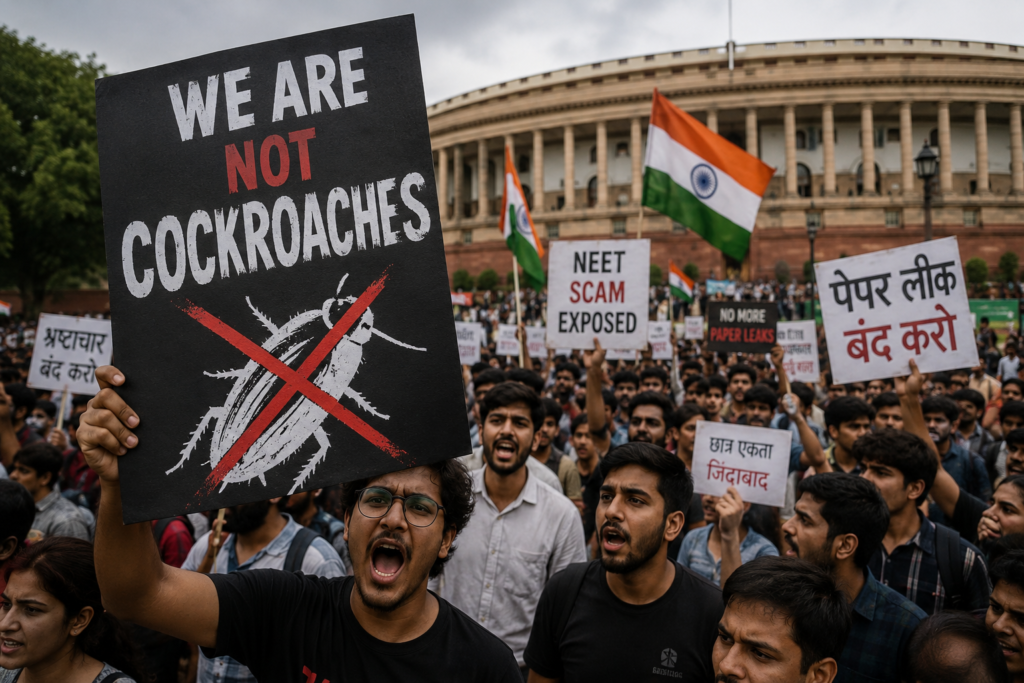
The Cockroach Janta Party, or CJP, began as a satirical online response after a judicial remark reportedly compared unemployed young people to “cockroaches.” Protesters subsequently adopted the label as a symbol of resilience and collective frustration. What started online in May 2026 moved into physical demonstrations at New Delhi’s Jantar Mantar and expanded into a broader campaign over examination integrity and government accountability.
The most immediate grievance concerns the NEET-UG 2026 examination, a critical route into medical education for approximately two million candidates. The Indian government confirmed that the Central Bureau of Investigation registered a case on 12 May following a complaint from the Department of Higher Education concerning alleged irregularities and a paper leak. Authorities later announced arrests and identified individuals suspected of distributing leaked examination material.
On 20 July, thousands of protesters attempted to march towards Parliament. The demonstration ended in clashes with police using batons and tear gas. Delhi Police reported approximately 180 injured people, including 60 protesters and 118 police or security personnel. Demonstrations continued at Jantar Mantar the following day.
Political pressure increased on 22 July when opposition parties disrupted parliamentary proceedings in support of the protesters. Education Minister Dharmendra Pradhan subsequently promised examination reforms and a parliamentary debate, while protesters continued to demand his resignation and wider institutional changes.
Assessment
The Cockroach movement should not be assessed solely as a dispute over one compromised examination.
Competitive examinations in India function as gateways to medical education, public-sector employment and social mobility. When those systems are perceived as unreliable, the impact extends beyond individual candidates. Families can lose substantial financial resources invested in tuition and examination preparation, while students may lose academic years or access to scarce professional opportunities.
The movement therefore represents a challenge to institutional credibility. Its central message is that formal pathways to advancement are no longer viewed by some young Indians as consistently fair, transparent or responsive.
Three characteristics increase its significance.
First, the movement is not controlled by a traditional political party. Its decentralised structure, satirical identity and social-media reach make it difficult to address through conventional political negotiation.
Second, its support is expanding beyond directly affected examination candidates. Families, professionals, activists, opposition politicians and sections of the Indian diaspora have participated or expressed solidarity.
Third, the response to the demonstrations has become part of the grievance. Police restrictions, temporary digital measures, arrests, transport closures and images of injured protesters can shift public attention from examination reform towards broader questions involving civic space and government legitimacy.
The movement does not currently represent a nationwide security crisis. It does, however, indicate that a technical administrative failure has connected with deeper concerns involving unemployment, educational inequality and confidence in state institutions.
Exposed Groups
Foreign residents and expatriate families
Residents of New Delhi may face temporary transport restrictions, increased police deployments and unpredictable access around Parliament, Jantar Mantar, Connaught Place, Janpath and adjoining government districts.
International students and education-sector organisations
Foreign universities, admission advisers, education providers and scholarship programmes may encounter questions regarding examination schedules, candidate eligibility, documentation and the reliability of official admission timelines.
Diplomatic missions and international organisations
Embassies, NGOs and international institutions operating near central government districts may experience access controls, staff commuting problems and increased security around official buildings.
Business travellers
Travellers attending meetings in central Delhi may encounter road diversions, metro-station closures, delayed ground transport and difficulty reaching government offices or commercial districts.
International employers and global mobility teams
Companies employing Indian graduates or supporting employees with university-age children may face examination-related uncertainty, employee stress and requests for flexible working arrangements during major demonstrations.
Media workers, researchers and civil-society organisations
Foreign journalists, analysts and NGO personnel covering the demonstrations face increased exposure near police lines, crowd-control operations and areas subject to movement restrictions.
Investors and foreign businesses
The protests are unlikely to alter India’s national investment environment in the immediate term. However, persistent institutional-confidence concerns may affect perceptions of human-capital development, administrative reliability and the government’s ability to manage youth expectations.
Operational Impact
Urban mobility disruption
Security restrictions around central New Delhi have already affected road and metro access. On 22 July, the Delhi Metro Rail Corporation temporarily closed 16 stations in central areas before reopening them later in the day. Further closures or restricted station access remain possible during announced marches or parliamentary demonstrations.
Localised safety exposure
The use of tear gas, batons, barricades and crowd-control formations creates a risk to bystanders as well as participants. Conditions can deteriorate quickly when demonstrators attempt to move beyond authorised protest areas.
Government-service delays
Access to ministries, Parliament-adjacent offices and government institutions may be restricted during major protest activity. Meetings involving public authorities could be postponed or moved online with limited notice.
Education and admissions uncertainty
Further reviews, court challenges or policy changes may affect examination results, re-examinations and university admission schedules. Organisations should distinguish between confirmed government decisions and rapidly circulating claims on social media.
Digital and communications disruption
Temporary internet restrictions or platform-access measures could be introduced if demonstrations escalate. This could affect ride-hailing, digital payments, remote work and real-time communication in specific areas.
Political and reputational exposure
Foreign organisations commenting publicly on the movement may become associated with a politically sensitive domestic issue. Companies and institutions should separate employee-welfare communications from political commentary.
Wider protest replication
The Cockroach identity is easily transferable. Similar demonstrations could emerge around state-level recruitment examinations, university grievances or unemployment, even where the original NEET dispute is not the principal issue.
Likelihood
Elevated
Further demonstrations and periods of localised disruption are likely while protesters remain mobilised, opposition parties continue applying parliamentary pressure and negotiations fail to produce a visible agreement.
The government’s promise of reforms may reduce immediate pressure, but resignation demands, allegations of police misconduct and broader youth grievances remain unresolved.
Nationwide violent escalation is not the most likely scenario. Continued rallies, solidarity protests, transport restrictions and episodic confrontations in New Delhi and other major cities are more plausible.
Time Horizon
30 days
The next month will be critical for determining whether the government can separate the examination-reform issue from the wider institutional-confidence crisis.
Key developments will include the substance of proposed reforms, progress in the criminal investigation, parliamentary debate, the future of the Jantar Mantar protest site and whether organisers announce new national mobilisation.
Failure to provide a credible administrative response could allow the movement to expand beyond education policy and become a more durable political platform.
Recommended Actions
For residents and travellers in New Delhi
Monitor Delhi Traffic Police and Delhi Metro Rail Corporation notices before entering central Delhi.
Avoid Jantar Mantar, Parliament Street, Janpath, India Gate approaches and nearby government districts during announced demonstrations.
Allow additional time for airport, railway and business transfers when routes pass through central areas.
Do not stop near police barricades to photograph or observe crowd-control operations. Leave the area early if security forces begin forming containment lines or demonstrators start moving beyond the authorised site.
Carry identification and maintain access to an offline copy of accommodation, transport and emergency-contact details.
For companies and international organisations
Identify employees whose normal commute crosses central Delhi and establish temporary remote-working or alternative-office arrangements.
Avoid scheduling essential government meetings or executive movements near Parliament during major protest announcements.
Confirm that drivers and security teams have at least two alternative routes that do not depend on central metro stations.
Provide staff with a single verified internal communication channel rather than forwarding unconfirmed social-media reports.
Review employee-assistance support for staff or families directly affected by examination cancellations and admission uncertainty.
For universities and education-sector operators
Verify examination, re-examination and admission decisions through the Ministry of Education, National Testing Agency, relevant courts or recognised university authorities.
Avoid giving students definitive advice based only on press reports or social-media posts.
Prepare for delayed documentation, altered admission windows or requests for additional verification from Indian applicants.
Communicate clearly with affected candidates about deadline flexibility where institutional policies permit.
For diplomatic and security teams
Map planned demonstrations against mission locations, residences, schools and routine staff transport routes.
Monitor whether the movement expands from Jantar Mantar into university districts, state capitals or transport hubs.
Maintain a distinction between peaceful assembly, localised police action and indicators of wider urban unrest.
Reassess protective posture only when confirmed protest locations or government restrictions affect mission operations.
Watch Indicators
- New protest or “march to Parliament” announcements from CJP organisers.
- Continued occupation or police clearance of the Jantar Mantar protest site.
- Specific examination reforms announced by the Ministry of Education.
- Results of the CBI investigation and additional arrests connected to the NEET leak.
- Parliamentary debate, ministerial resignation demands or opposition walkouts.
- Delhi Metro station closures and central Delhi traffic advisories.
- Orders restricting public assembly or movement around government districts.
- Internet restrictions, platform blocks or disruptions to mobile connectivity.
- Expansion of demonstrations to Mumbai, Bengaluru, university centres or state capitals.
- Participation by trade unions, established student organisations or professional associations.
- Evidence that grievances are shifting from examination reform towards broader unemployment or governance demands.
- Embassy or foreign-government notices concerning demonstrations in New Delhi.
Confidence Level
High
The immediate examination leak, criminal investigation, demonstrations, injuries, parliamentary disruption and transport restrictions have been confirmed through official Indian government statements and multiple international news organisations.
There remains uncertainty regarding protest participation figures, the movement’s internal structure and its ability to sustain mobilisation outside New Delhi.
The assessment that the movement represents an institutional-confidence signal is analytical rather than a direct measurement of nationwide public opinion. It is supported by the widening of protesters’ demands, continued mobilisation and the involvement of groups beyond the original examination candidates.
SafeExpat Assessment
India’s Cockroach movement is a warning that failures in high-stakes education and recruitment systems can rapidly become wider legitimacy issues.
The immediate operational exposure remains concentrated around demonstrations, transport restrictions and government districts in New Delhi. The more significant strategic signal is the movement’s ability to connect examination integrity with employment insecurity, social mobility and public confidence in institutions.
Government concessions could contain the immediate protest cycle. A response perceived as procedural, delayed or coercive would increase the likelihood that the Cockroach identity develops into a broader and more persistent vehicle for youth dissatisfaction.
For internationally mobile people and organisations, the appropriate posture is enhanced awareness rather than alarm: monitor protest geography, protect mobility, verify education-related decisions and avoid interpreting the movement as either a temporary student dispute or an imminent nationwide crisis.