Editorial Product
SafeExpat DOSSIER
Executive Summary
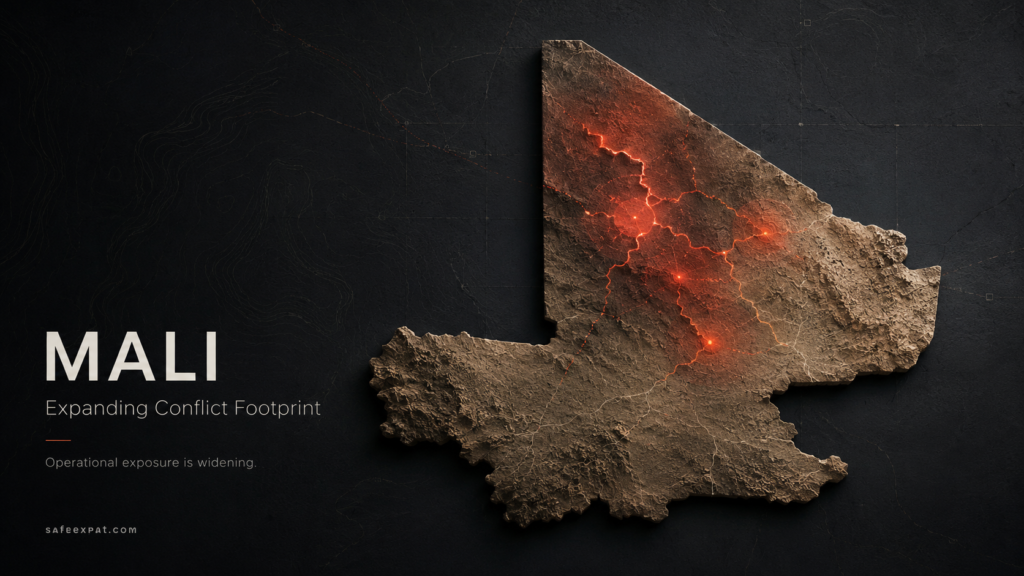
Mali’s security environment has deteriorated further after coordinated attacks struck military positions across northern, central and southern areas on 4 July 2026.
The attacks matter because they show that armed groups retain the capacity to operate across multiple regions, including near areas linked to government and Russian-backed forces.
For expats, NGOs, companies, diplomatic personnel and regional mobility teams, Mali should now be treated as a high-friction operating environment where movement, extraction planning, supply access and consular support may be constrained.
The immediate concern is not only battlefield violence, but the widening operational pressure on roads, fuel supply, airports, urban security posture and foreign personnel exposure.
Signal
On 4 July 2026, Mali’s armed forces reported attacks on several locations, including Aguelhok, Anefis and Gao in the north, Sévaré in central Mali and Kenioroba in the south. Reuters reported that both the Tuareg-led Azawad Liberation Front and al-Qaeda-linked Jama’at Nusrat al-Islam wal-Muslimin claimed involvement, while some battlefield claims could not be independently verified.
The development follows a larger April 2026 offensive by JNIM and the FLA, which analysts described as a turning point in Mali’s conflict dynamics because it indicated a tactical alignment between jihadist and separatist actors that had previously been divided by ideology and objectives.
Official travel advisories already reflect severe exposure. The U.S. State Department lists Mali as Level 4, “Do Not Travel,” citing crime, terrorism, unrest, health risks and kidnapping. The UK FCDO advises against all travel to Mali and says those already in the country should leave by commercial flight if safe to do so, while avoiding overland routes.
Assessment
The latest attacks indicate that Mali’s conflict is no longer confined to remote northern battle zones. The geographic spread of incidents suggests that armed groups can generate pressure across multiple axes, forcing the state to divide security resources and complicating movement planning for civilians, organizations and foreign personnel.
The key operational issue is the erosion of predictability. Even where the government claims to have restored control, the ability of armed actors to launch coordinated attacks creates short-notice disruption risk for airports, roads, fuel convoys, checkpoints, hotels, compounds and local partner movements.
Mali’s pivot away from French and European military support toward Russian-backed security assistance has not produced a stable security environment. The Soufan Center assessed in May 2026 that the JNIM-FLA offensive exposed limits in the capabilities of Mali’s junta and Russian Africa Corps support, particularly outside core regime-security areas.
For SafeExpat users, the practical consequence is clear: Mali should be treated less as a conventional destination risk and more as a layered operating-risk environment involving armed conflict, kidnapping, transport disruption, weak emergency response and limited external evacuation support.
Exposed Groups
Foreign nationals already in Mali face the highest exposure, especially those outside Bamako or those whose work requires road movement.
NGOs, humanitarian staff, journalists, security contractors, mining personnel, infrastructure teams and local implementation partners face elevated risk because their work may require field access, reliance on local routes or visibility to armed groups.
Business travelers, consultants, regional executives and mobility teams face exposure through airport disruption, curfews, sudden movement restrictions, checkpoint delays and limited medical evacuation options.
Families, students, remote workers and long-stay foreign residents face compounding risk from fuel shortages, restricted movement, unreliable consular support and the need to shelter in place during security operations.
Local partners and national staff may face the most persistent risk, including road insecurity, identity checks, intimidation, recruitment pressure, economic disruption and retaliation allegations by either armed groups or security forces.
Operational Impact
Mobility disruption is the primary near-term impact. Road travel outside Bamako should be considered highly exposed, particularly on routes affected by armed checkpoints, fuel blockades, military operations or insurgent activity.
Airport access and flight reliability require close monitoring. Even if Bamako’s international airport remains open, access routes, fuel availability, security alerts or nearby attacks could affect departures at short notice.
Kidnapping exposure remains severe. Foreign nationals, NGO staff, contractors and personnel linked to international organizations or extractive industries may be viewed as high-value targets.
Supply-chain disruption is likely to persist where fuel convoys, commercial transport and intercity roads are targeted or restricted. This can affect generators, vehicle fleets, food availability, medical access and the ability of organizations to maintain secure operations.
Consular support may be limited. The UK explicitly warns that support for British nationals is severely limited, especially outside Bamako, and the U.S. restricts official personnel movement outside the capital.
Reputational and duty-of-care exposure is also rising for organizations that continue non-essential deployments without documented risk acceptance, evacuation planning and staff accountability protocols.
Likelihood
High.
Further disruption is highly likely because the latest attacks were coordinated across several locations and follow a larger April offensive that changed the conflict tempo. Even if the state retains control of Bamako and key facilities, the ability of armed groups to pressure multiple regions makes additional attacks, road insecurity and security-force responses probable.
A sudden nationwide collapse is not the base case. The more likely scenario is continued fragmentation: government control over core urban and strategic zones, contested access in northern and central regions, and periodic attacks designed to overstretch state capacity.
Time Horizon
30 days.
The next month is the critical window for determining whether the July attacks remain a coordinated pressure operation or become the opening phase of a broader campaign to consolidate rebel and jihadist gains.
For organizations, this timeframe matters because evacuation options, commercial flight reliability, fuel access, insurance validity and staff relocation decisions may change faster than internal corporate approval cycles.
Recommended Actions
Foreign nationals should defer all non-essential travel to Mali. Existing official advisories from the U.S., UK and New Zealand already recommend against travel or immediate departure where safe commercial options exist.
Organizations with personnel in Mali should conduct a same-week headcount and location confirmation for all international and national staff, including dependents, contractors and local partners.
Review evacuation planning against current reality, not legacy assumptions. Plans should distinguish between air departure from Bamako, internal relocation to a secure site and extended shelter-in-place if air travel becomes unavailable.
Suspend routine road movements outside Bamako unless mission-critical, security-cleared and supported by live route intelligence. Overland exit to neighboring countries should not be treated as a default evacuation option.
Check insurance, medical evacuation coverage and crisis-response contracts. Travel against government advice may affect insurance validity, and medical evacuation may be delayed by airport access, airspace restrictions or security incidents.
Reduce visibility of foreign-linked movements. Avoid predictable routines, branded vehicles, unnecessary public meetings, and hotel or restaurant patterns known to host foreign personnel.
Prepare for fuel and cash constraints. Maintain verified fuel reserves, generator plans, cash access, satellite or backup communications, medication stocks and safe accommodation options.
Global mobility teams should update duty-of-care records, document risk acceptance for any remaining staff, and brief families on communication protocols, emergency contacts and decision triggers.
Watch Indicators
Monitor official embassy alerts from the U.S., UK, France, EU missions and other relevant national authorities.
Track airport status, flight cancellations, airline schedule changes and access conditions around Bamako.
Watch for new claims or communiqués from JNIM, FLA or other armed actors, especially references to Bamako, fuel corridors, airports, foreign personnel or strategic towns.
Monitor reports of attacks or blockades on fuel trucks, commercial convoys and national highways.
Track curfews, state-of-emergency measures, checkpoints, mobile internet restrictions or temporary closures of schools, offices and public facilities.
Watch for changes in government or Africa Corps deployments, especially redeployments from Bamako toward northern or central flashpoints.
Monitor local media and trusted security feeds for activity in Gao, Kidal, Anefis, Aguelhok, Sévaré, Mopti, Konna and approaches to Bamako.
Track signs of cross-border spillover into Burkina Faso, Niger, Mauritania and Côte d’Ivoire, particularly if armed groups attempt to widen pressure beyond Mali.
Confidence Level
Medium.
Confidence is medium because the overall deterioration is supported by multiple reliable sources, official advisories and consistent reporting on coordinated attacks. However, battlefield control claims by the Malian army, JNIM and FLA remain difficult to verify independently, and access constraints limit real-time confirmation outside major urban areas.
SafeExpat Assessment
Mali has entered a more complex conflict phase in which armed actors are demonstrating wider geographic reach, stronger coordination and the ability to impose operational costs beyond the battlefield.
For foreign nationals and organizations, the central risk is not a single incident but a deteriorating operating environment: restricted movement, uncertain extraction options, high kidnapping exposure, weak medical and consular support, and rising pressure on supply routes.
SafeExpat assesses Mali as a high-exposure destination requiring essential-only presence, documented risk ownership and active exit or shelter-in-place planning. The operating assumption should be that disruption can expand with limited warning.