Editorial Product: SafeExpat WATCHING
Executive Summary
Mexican criminal groups are showing a growing capacity to employ improvised explosive devices, including vehicle-borne bombs, drone-delivered explosives and landmine-style devices.
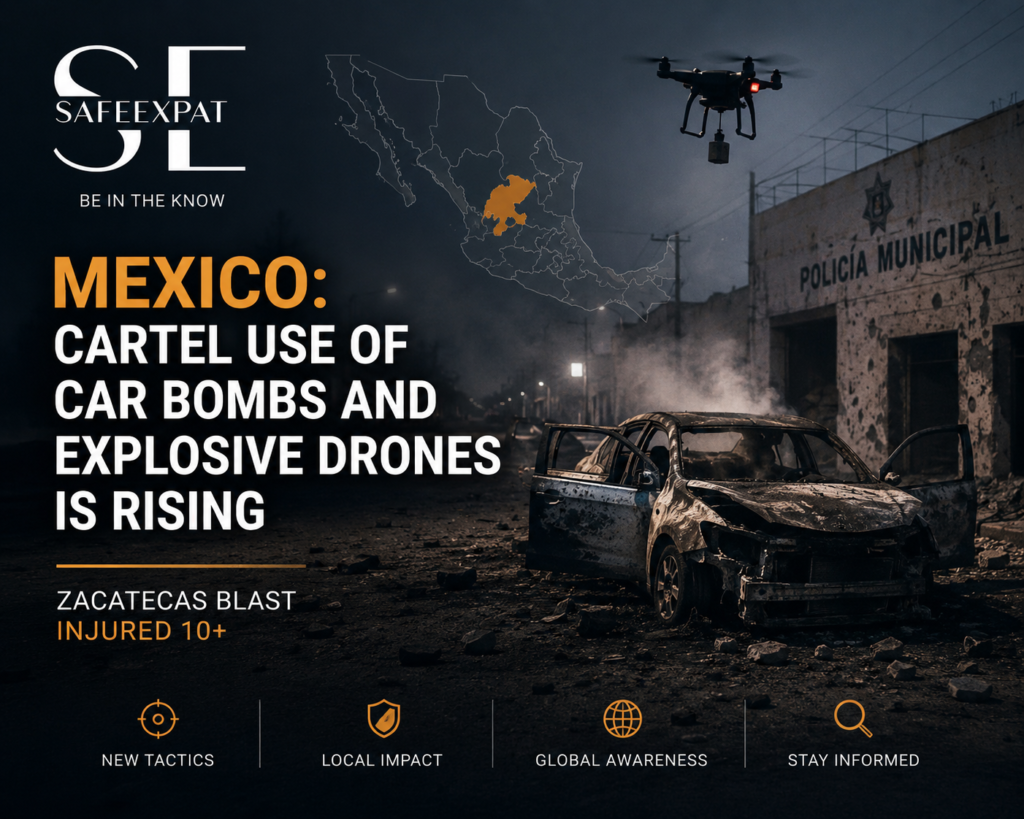
The latest warning came from Ojocaliente, Zacatecas, where an explosive-laden vehicle detonated outside municipal police headquarters on 30 August, injuring at least 11 people, including police officers, and damaging dozens of nearby properties. State authorities have linked the attack to an apparent retaliation following an arrest.
For foreign residents and organizations, the principal concern is not a generalized bombing threat across Mexico. It is the increasing possibility that cartel confrontations with security forces produce blast, drone and secondary mobility risks in civilian environments, particularly in contested municipalities.

Signal
The Ojocaliente attack represents more than another episode of cartel violence.
An explosive-equipped vehicle was positioned outside the municipal police command facility and detonated in a populated area. Latest reporting places the number of injured at at least 11, while damage extended to dozens of buildings and vehicles. Earlier casualty and property-damage figures varied as authorities assessed the scene.
Zacatecas authorities suspect the attack was retaliation following the detention of an alleged criminal-group member. State officials have pointed toward the Jalisco New Generation Cartel (CJNG), although this attribution should presently be treated as an official assessment rather than independently established responsibility.
More significant is the trajectory.
According to Zacatecas Governor David Monreal and state security officials cited by Reuters, incidents involving explosives in the state increased from one in 2024 to six in 2025 and ten so far in 2026, involving tactics that include vehicle bombs, explosive-equipped drones and mine-type devices.
Operational discoveries reinforce the assessment. On 20 August, security forces in Jiménez del Teul, Zacatecas, located a suspected organized-crime compound containing 22 improvised explosive devices, roughly 30 kilograms of explosive material and detonation components.
The capability is not entirely new. In January 2024, Mexico’s National Guard and Army recovered 13 improvised explosive devices in Villanueva, Zacatecas; eight were specifically configured for deployment from drones.
Assessment
SafeExpat assesses that the important development is tactical diffusion rather than simply an increase in violence.
Explosives allow criminal groups to attack security forces from greater distance, create uncertainty around roads and facilities, retaliate against law-enforcement operations and inflict disruption disproportionate to the number of attackers involved.
Weaponized commercial drones further change the operating environment. They can provide surveillance before an attack and, when adapted to carry explosives, potentially strike targets inaccessible without direct armed confrontation.
There is particularly strong evidence of this evolution in Michoacán. Mexico’s Defence Secretary stated in July that authorities had detected 625 improvised explosive devices since November 2025 in parts of the state and were conducting specialized mine-clearance operations. Authorities have also been developing anti-mine vehicles and considering additional drone-detection capabilities.
Michoacán authorities separately reported seizing 1,645 explosive devices during 2025, illustrating the industrial scale at which explosive material can circulate within some contested criminal environments.
This does not mean Mexico is transitioning uniformly toward indiscriminate bombing. Current evidence still points predominantly toward geographically concentrated criminal conflicts and attacks connected to security forces, rival groups, territorial control and retaliation.
The operational distinction matters: exposure is likely to be highly localized but potentially severe when it occurs.
Exposed Groups
The highest relative exposure is likely among:
- Foreign personnel living or travelling through contested municipalities in Zacatecas, Michoacán and other areas where explosive incidents are documented.
- NGO, humanitarian, agricultural, mining, logistics and infrastructure personnel operating outside major urban centres.
- Corporate drivers and business travelers using secondary highways or travelling near active security operations.
- Journalists and researchers covering organized crime or security-force deployments.
- Expat families living close to police, military or government security installations in affected municipalities.
- Global mobility and corporate security teams responsible for road movements, local contractors or distributed workforces.
- Local employees and partners whose daily movements routinely intersect with police facilities, checkpoints or contested rural corridors.
Ordinary tourists in Mexico’s principal tourism zones should not interpret this signal as evidence of a nationwide explosive threat. Geographic context remains critical.
Operational Impact
The most probable consequences for internationally mobile populations are indirect.
Security-facility exposure: Police stations, military positions and security-force concentrations may become higher-consequence locations during periods of cartel retaliation.
Road disruption: Discovery of suspected explosive devices can result in road closures, security cordons and lengthy inspection operations, particularly along rural routes.
Abandoned-vehicle risk: Vehicles positioned near police facilities or along contested routes may increasingly require greater caution from local authorities and security teams.
Drone-related exposure: Small UAV activity around security operations can no longer automatically be regarded as recreational or benign in selected high-risk areas.
Business continuity: Sudden security operations may delay employee movements, logistics, site access and contractor activity without necessarily generating national-level travel warnings.
Civilian blast exposure: The Ojocaliente incident demonstrates that an attack principally directed against authorities can produce casualties and structural damage beyond the intended target.
Likelihood
Elevated
Further localized incidents involving improvised explosives are plausible, particularly in jurisdictions where rival criminal organizations are competing for territory or responding to arrests and security operations.
The combination of repeated attacks, significant explosive-device seizures and confirmed drone-compatible devices demonstrates an established capability rather than a theoretical threat.
SafeExpat does not currently assess the likelihood of indiscriminate explosive attacks across Mexico as High. The threat remains concentrated around specific criminal-security environments.
Time Horizon
30 days
The immediate period is relevant because retaliatory violence can follow arrests, seizures and enforcement operations quickly, while Zacatecas is already experiencing a sequence of explosive-related incidents.
The broader capability should also be monitored over the 3–6 month horizon, particularly for evidence that these tactics are spreading geographically or shifting from predominantly security targets toward commercial infrastructure or civilian coercion.
Recommended Actions
For residents and travelers in affected Mexican states, avoid unnecessarily waiting, parking or arranging pickups immediately outside police headquarters, military facilities or other security installations when local tensions are elevated.
For road movements through contested areas, route planning should incorporate recent security incidents rather than relying solely on normal travel-time applications. Corporate drivers should have an agreed diversion and check-in procedure before entering remote corridors.
Do not approach abandoned vehicles, unusual containers or suspected explosive remnants following clashes or security operations. Maintain distance and follow local-authority instructions.
Organizations with staff in higher-risk municipalities should incorporate explosive-device and drone incidents into journey-risk assessments, rather than treating armed confrontation as the only cartel-related mobility threat.
Accommodation and long-term residential assessments in highly contested municipalities should consider proximity to police commands, military bases and recurrent security-force deployment points.
Corporate security teams should also distinguish between Mexico-wide risk and municipality-level exposure. Blanket restrictions may be operationally inefficient; targeted movement controls around confirmed hotspots are more proportionate.
Watch Indicators
SafeExpat will monitor:
- Further vehicle-borne explosive attacks against police or military facilities.
- Recovery of drone-adapted explosive devices in Zacatecas or neighboring states.
- Significant arrests followed by explicit criminal retaliation threats.
- Increased military explosive-ordnance-disposal deployments.
- Mine or IED discoveries along public highways.
- Road closures associated with suspected explosive devices.
- Expansion of explosive attacks beyond Michoacán and Zacatecas.
- Attacks against commercial, logistics, energy or other non-security infrastructure.
- Embassy or foreign-government security notices specifically addressing explosives or weaponized drones.
- Mexican federal measures introducing additional counter-drone or counter-IED capabilities.
Confidence Level
High
The central assessment is supported by Reuters reporting, Mexican federal government statements, National Guard records and official Zacatecas and Michoacán security reporting documenting both attacks and substantial seizures of improvised explosive devices.
Uncertainty remains over individual cartel attribution, the precise national prevalence of these tactics and whether current growth represents lasting geographic diffusion or concentration within a limited number of criminal conflicts.
SafeExpat Assessment
Mexico’s explosive threat should currently be understood as a capability shift, not a nationwide terrorism-style threat.
Cartel violence has historically been dominated by firearms, roadblocks, vehicle seizures and direct armed confrontation. The expanding operational use of improvised explosives, weaponized drones and mine-type devices adds a different risk layer: greater stand-off capability, less predictable blast exposure and increased danger around security infrastructure and contested road networks.
For globally mobile populations, the intelligence requirement is therefore becoming more granular.
The question is no longer simply whether a Mexican state has cartel activity. Increasingly, it is where criminal groups possess explosive capability, what they are targeting, and whether routine movements intersect with those targets.
That distinction should drive mobility decisions.