Editorial Product
SafeExpat DOSSIER
Executive Summary
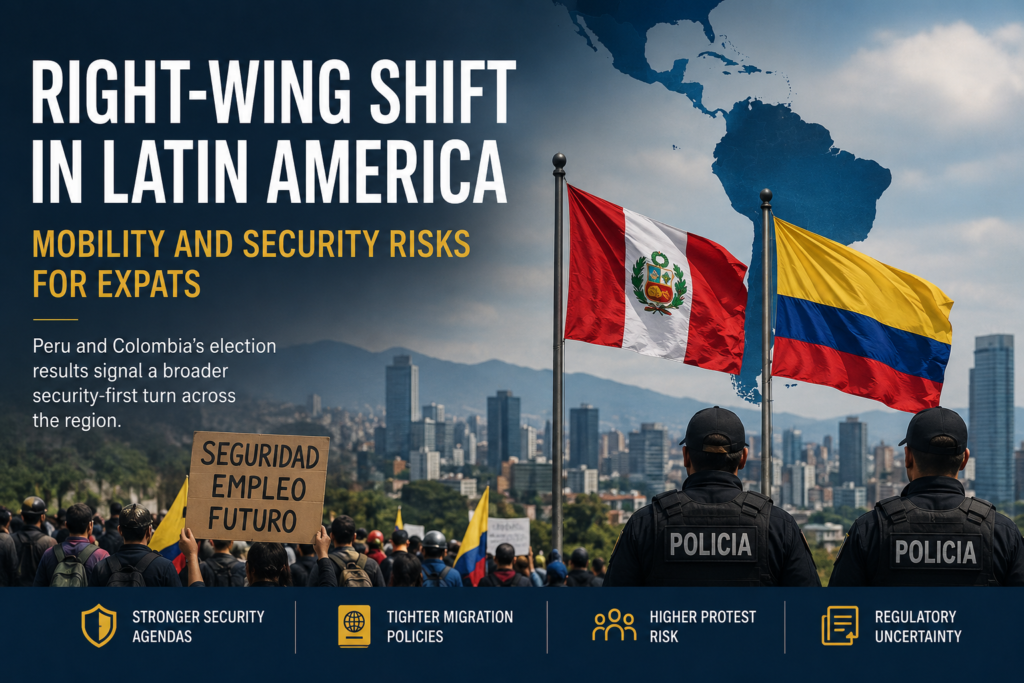
Recent presidential victories by right-wing candidates in Peru and Colombia point to a broader political shift across Latin America.
The signal is not simply ideological. It reflects voter frustration with crime, migration pressure, weak institutions, corruption, inflation and insecurity.
For expats, travelers, NGOs, investors, students and global mobility teams, the main exposure is policy volatility: tougher security measures, more politicized migration debate, protest risk and possible changes in regulation or cross-border cooperation.
The emergence of a formal conservative regional alliance remains uncertain. The more immediate issue is operational: several governments are moving toward security-first governance at the same time.
Signal
Peru and Colombia have both moved sharply to the right after closely contested presidential elections.
In Peru, Keiko Fujimori was declared winner of the 2026 presidential runoff by the national electoral office, defeating Roberto Sánchez by a narrow margin of 50.135% to 49.865%. The result followed weeks of disputed ballots, fraud allegations and protests.
In Colombia, Abelardo De La Espriella won the presidential runoff against left-wing senator Iván Cepeda by around one percentage point. Cepeda later conceded the election, while the campaign was marked by polarization, security concerns and support for harder-line policies on crime.
These victories add to a wider rightward shift in the region. Reuters has described Colombia’s result as reinforcing a trend that already includes Argentina, Chile, Ecuador, Bolivia and Panama moving away from recent left-wing governments.
Assessment
This is best understood as a governance and mobility-risk signal, not only a political story.
The common driver across several countries is public demand for stronger action on crime, extortion, drug trafficking, irregular migration and economic stagnation. Right-wing and populist candidates have converted those concerns into law-and-order platforms, often borrowing rhetoric associated with U.S. President Donald Trump and El Salvador’s Nayib Bukele.
For internationally mobile groups, the key issue is whether governments translate campaign language into policy. This may include expanded police or military powers, border militarization, new prison policies, stricter immigration enforcement, regulatory changes affecting NGOs, and closer security cooperation with the United States.
A formal conservative regional alliance is not yet confirmed. However, policy alignment may emerge informally through shared positions on crime, migration, Venezuela, organized crime, U.S. relations, energy policy and anti-left regional diplomacy.
Exposed Groups
Expats living in Peru, Colombia and neighboring countries may face more visible security operations, protest disruption and political polarization in urban centers.
Business travelers and investors may benefit from pro-market signals in some sectors, but should also expect volatility around demonstrations, regulatory reform and public-sector restructuring.
NGOs, human rights organizations and civil society actors may face closer scrutiny if new governments frame security, foreign funding or migration as national-sovereignty issues.
Remote workers and digital nomads could be affected by changes in visa enforcement, tax compliance, policing in major cities and the tone of public debate around foreigners.
Families and students should monitor demonstrations, transport disruption and security measures near universities, government buildings, central plazas and major roads.
Global mobility teams should expect country-risk profiles to change unevenly. Some destinations may become more business-friendly while also becoming more politically polarized.
Operational Impact
The most likely operational impacts are not immediate nationwide instability, but localized disruption and policy uncertainty.
In Peru, the narrow result and history of institutional instability increase the likelihood of protests, legal challenges and government-congress friction. Mobility disruption is most likely around Lima, regional capitals, mining corridors and government buildings.
In Colombia, the transition from Gustavo Petro’s left-wing administration to a hardline security-focused government may affect peace talks, rural security, energy policy, policing priorities and relations with armed groups. Reuters reported that the president-elect has already selected a retired major general as incoming defense minister, reinforcing expectations of a tougher security posture.
Across the region, foreign nationals may see more security checkpoints, stronger border messaging, immigration-document checks, and heightened rhetoric around migrants and crime.
Companies should also prepare for reputational exposure. Public alignment with politically sensitive projects, extractive industries, security contractors or controversial government programs may attract scrutiny.
Likelihood
Elevated.
Further policy movement to the right is likely because the election outcomes are confirmed or conceded, and because crime and insecurity remain powerful political drivers. However, escalation into a coordinated regional bloc is less certain.
The higher-probability scenario is parallel policy convergence: governments independently adopting tougher security, migration and economic policies while cooperating selectively with like-minded administrations.
Time Horizon
3–6 months.
This timeframe covers the immediate transition period, early cabinet formation, first security announcements, protest cycles, and initial regulatory or diplomatic moves.
Short-term disruption may occur within 24–72 hours around demonstrations or contested political events, but the more important mobility and compliance risks will develop over the next several months.
Recommended Actions
Review country risk ratings for Peru, Colombia and neighboring states with attention to political stability, protest risk, migration enforcement and security operations.
For travel to Lima, Bogotá, Medellín, Cali and major regional capitals, build extra flexibility into ground transport plans during political rallies, inauguration periods and major policy announcements.
Organizations with staff in rural Colombia should reassess exposure to armed-group dynamics, especially if peace talks are suspended or security operations expand.
NGOs and civil society groups should review registration, funding, tax and reporting obligations. Political transitions can increase scrutiny of foreign-linked organizations.
Employers and global mobility teams should confirm that foreign staff hold valid immigration status, local ID documents, work authorizations and proof of address where required.
Investors should separate market optimism from operating risk. A pro-business government may still face protests, legislative obstruction, legal challenges or social conflict.
Families and students should avoid demonstrations, even peaceful ones, and monitor embassy notices before moving near government buildings, universities or central plazas.
Travelers should keep digital and physical copies of passports, visas, residence cards, insurance documents and emergency contacts accessible offline.
Watch Indicators
Monitor official election and transition announcements in Peru and Colombia.
Track protest calls by opposition parties, unions, student groups, Indigenous organizations and civil society movements.
Watch for new border-security measures, immigration inspections or visa-enforcement announcements.
Follow police and military deployments in city centers, transport hubs, mining regions and rural security corridors.
Monitor embassy advisories from the United States, Canada, the United Kingdom, the European Union and regional governments.
Track announcements on Colombia’s peace talks, counter-narcotics policy, oil and fracking policy, and rural security operations.
Watch for changes in NGO regulation, foreign funding rules, public-order laws or emergency powers.
Monitor local media for roadblocks, strikes, airport disruption, curfews or localized unrest.
Confidence Level
Medium.
The election outcomes in Peru and Colombia are supported by major international reporting and official or near-official electoral information. The broader rightward trend is also supported by regional analysis.
Confidence is lower on the formation of a formal conservative alliance. Current evidence supports ideological and policy convergence, but not yet a structured regional bloc with binding coordination.
SafeExpat Assessment
The rightward shift in Peru and Colombia should be treated as an operational early-warning signal for Latin America.
The primary risk is not ideology itself, but the speed at which security-first governments may change policing, migration enforcement, foreign relations and regulatory priorities.
For globally mobile individuals and organizations, the coming months require closer monitoring of protests, border policy, public-security operations and compliance exposure. The region is entering a more polarized policy cycle in which local political change may quickly become a mobility, safety and operating-risk issue.