Editorial Product: SafeExpat WATCHING
Executive Summary
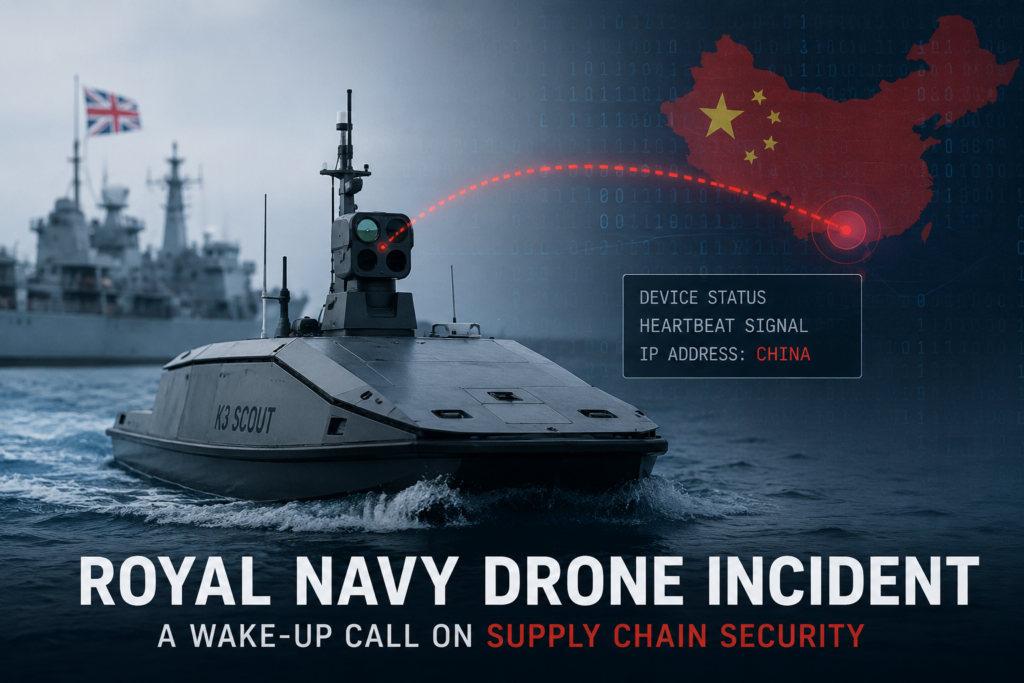
A cyber vulnerability assessment of a Royal Navy K3 Scout uncrewed surface vessel identified camera-system communications with an IP address in China, according to reporting published on 9–10 August 2026. The communications were described as routine “heartbeat” signals indicating device status rather than imagery or operational intelligence.
The UK Ministry of Defence says a subsequent investigation found no evidence that MoD data or systems were accessed, compromised or transmitted externally. Internet connectivity associated with the affected camera subsystem was reportedly removed as part of the response.
The more significant intelligence signal is therefore not a confirmed Chinese intelligence breach, but the exposure created when third-party connected components enter sensitive defence platforms without their external communications being fully understood before deployment.
For international companies, diplomatic organisations, critical-infrastructure operators and global security teams, the incident reinforces a wider principle: the declared nationality of a platform or prime contractor does not necessarily indicate the provenance, software behaviour or network dependencies of every subsystem inside it.
Signal
On 11 March 2026, the Royal Navy announced the purchase of 20 uncrewed surface vessels from UK-based Kraken Technology Group under a £12.3 million contract associated with Project Beehive. The vessels are intended for the Coastal Forces Squadron and 47 Commando Royal Marines for operational, training and development activities as Britain expands its combination of crewed and uncrewed naval systems.
Reporting on 9 August subsequently revealed that a camera subsystem installed aboard K3 Scout vessels had been detected communicating with an IP address in China. The traffic was characterised as “heartbeat communications” used to indicate that the device was online and functioning. The cameras were reportedly obtained through a third-party supplier.
The MoD said the issue was detected during a routine cyber vulnerability assessment and stated that its investigation found no evidence of MoD systems or data being accessed, compromised or transmitted externally.
This distinction is important. Current evidence supports the existence of an undesirable or previously unidentified external communication pathway. It does not currently establish that surveillance footage, classified information or operational data was transferred to Chinese authorities.
Assessment
SafeExpat assesses the incident primarily as a technology supply-chain assurance failure signal.
Modern autonomous platforms are assembled from layers of hardware, firmware, sensors, communications equipment and software supplied through multiple vendors. Security therefore depends not only on the prime contractor but also on the provenance and behaviour of individual components.
This becomes particularly significant when equipment contains connected cameras, telemetry modules, navigation systems or other components capable of generating outbound network traffic.
The K3 Scout case is particularly relevant because the Royal Navy has explicitly designed Project Beehive around rapid experimentation and an open architecture allowing new capabilities to be integrated quickly. That approach provides operational flexibility, but it also increases the importance of controlling the security of every component introduced into the platform.
The broader strategic environment amplifies the issue. The UK’s 2025 Strategic Defence Review describes Chinese technology proliferation as a significant challenge for British defence and assesses China as likely to continue pursuing advantage through espionage, cyber operations and acquisition of advanced intellectual property.
The incident therefore demonstrates a recurring problem for defence organisations and internationally exposed companies: trusted procurement chains can still contain unrecognised digital dependencies several layers below the principal supplier.
Exposed Groups
Potentially relevant exposure extends beyond the Royal Navy.
Higher relevance
- Defence and aerospace organisations integrating commercial or third-party sensors
- Maritime-security and autonomous-system operators
- Government contractors and subcontractors
- Diplomatic and security organisations operating sensitive facilities
- Critical-infrastructure operators using network-connected surveillance equipment
- Cybersecurity and procurement teams responsible for hardware assurance
Secondary relevance
- International corporations operating sensitive sites abroad
- NGOs handling politically sensitive activities
- Security managers responsible for executive or facility protection
- Global mobility teams managing personnel at strategic or restricted facilities
- Investors and companies dependent on complex Chinese-linked technology supply chains
For ordinary travelers or expatriates in the United Kingdom, there is currently no identified direct personal-security or mobility consequence.
Operational Impact
The immediate operational impact appears contained because the vulnerability was identified and investigated.
The longer-term consequences could be more significant.
Defence organisations may expand inspections of cameras, telemetry devices and communications components embedded in autonomous platforms. Contractors could face additional requirements concerning component provenance, firmware, network behaviour and subcontractor disclosure.
Similar reviews could extend beyond uncrewed vessels to other connected equipment where commercially sourced sensors are incorporated into sensitive systems.
For international organisations, the practical risk is that seemingly peripheral devices — cameras, environmental sensors, access-control systems or communications modules — may generate outbound traffic that was not fully identified during procurement.
Even when the transmitted information is operationally insignificant, an external connection can reveal metadata such as device activation, network presence or operating patterns and can create a pathway requiring further security assessment.
Likelihood
Elevated
Further scrutiny of defence supply chains and connected components is likely following the disclosure.
The incident arrives while the Royal Navy is actively expanding autonomous capabilities and while the UK government has already identified technological dependency, cyber exposure and foreign supply-chain influence as strategic security concerns.
There is currently insufficient evidence, however, to assess that the discovered communications represent deliberate Chinese espionage or that wider compromise of the K3 fleet occurred.
Time Horizon
30 days
The next several weeks should indicate whether the incident remains confined to a specific camera subsystem or triggers a wider examination of connected components across UK defence equipment.
Parliamentary scrutiny, additional MoD disclosures, supplier statements or procurement reviews could materially change the assessment.
Recommended Actions
Organisations operating sensitive connected equipment should:
- Audit outbound connections from embedded devices. Identify external IP addresses, cloud platforms, telemetry servers and vendor infrastructure contacted by cameras, sensors and autonomous systems.
- Move beyond supplier declarations. Security assurances should be supported by technical verification of hardware provenance, firmware behaviour and network traffic.
- Map the full component chain. Maintain hardware and software bills of materials that extend beyond the primary contractor into subcontractors and component manufacturers.
- Apply default-deny connectivity to sensitive equipment. Cameras and sensors should not require unrestricted internet access unless an operational requirement has been established and approved.
- Segment connected devices. Surveillance, autonomous and IoT systems should operate within controlled network environments capable of detecting anomalous outbound traffic.
- Review equipment used in sensitive locations. Diplomatic missions, defence contractors and international organisations should pay particular attention to connected devices positioned near secure discussions, restricted areas or operational planning spaces.
- Treat metadata as intelligence. Even communications that do not contain substantive operational data can potentially reveal patterns concerning equipment availability, location, activity or deployment cycles.
Watch Indicators
SafeExpat is monitoring for:
- Additional statements from the UK Ministry of Defence or Royal Navy
- Confirmation of the manufacturer and origin of affected camera components
- Evidence clarifying exactly what information was contained in the outbound communications
- Expansion of the investigation to other Kraken platforms or Royal Navy systems
- Parliamentary requests for wider audits of defence equipment
- New procurement rules concerning Chinese-origin electronic components
- Supplier or subcontractor disclosures
- Additional remediation measures beyond removal of internet connectivity
- Similar findings involving connected defence, infrastructure or surveillance systems in NATO countries
Confidence Level
High
The existence of the affected subsystem and the security investigation is supported by an attributable Ministry of Defence statement, while the Royal Navy independently confirms the K3 Scout procurement, fleet size, programme value and intended operational users.
Confidence is lower regarding claims that could imply deliberate espionage. Publicly available evidence currently establishes communications with a China-linked endpoint but does not demonstrate that sensitive imagery or operational information was transferred, nor that the communications were directed by the Chinese government.
SafeExpat Assessment
The K3 Scout incident should not presently be characterised as a confirmed Chinese penetration of Royal Navy systems.
Its intelligence significance lies elsewhere.
A British-built autonomous platform intended for sensitive defence operations contained a third-party subsystem capable of communicating externally in a manner sufficiently concerning to trigger investigation and remediation.
For organisations operating across borders, the lesson is operational: technology sovereignty cannot be assessed at the platform or vendor level alone. It has to extend to components, firmware, communications behaviour and the entire underlying supply chain.
As autonomous and connected systems become more deeply integrated into defence, infrastructure and corporate security environments, component-level visibility is becoming a prerequisite for operational trust.