Editorial Product
SafeExpat WATCHING
Executive Summary
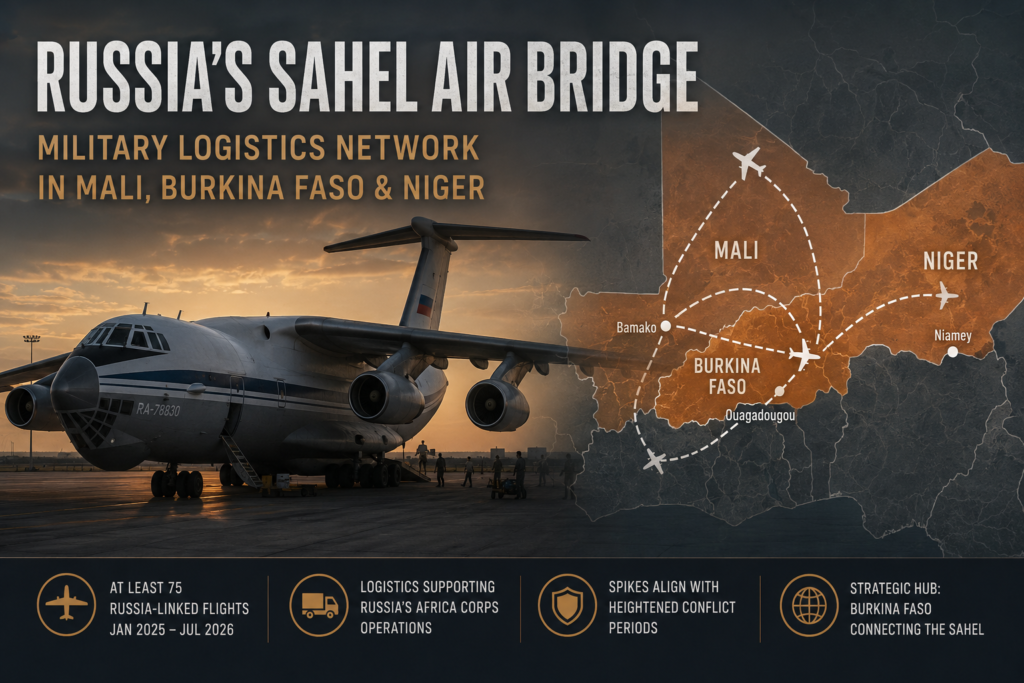
Open-source flight analysis has identified at least 75 Russian military-linked flights involving Mali, Burkina Faso and Niger between 1 January 2025 and 31 July 2026, revealing a persistent air logistics architecture supporting Russia-aligned operations in the central Sahel.
Burkina Faso appears to function as the network’s principal regional hub, while Russian state aircraft and private carriers use different transit corridors through North Africa, the Middle East and commercial aviation hubs.
More importantly for operational monitoring, periods of increased Russian flight activity have coincided with political movements and intensified fighting, suggesting that abnormal flight activity could become an indications-and-warning signal for deteriorating conditions on the ground.
For expatriates, NGOs, diplomatic personnel, international companies and mobility teams, the immediate concern is not the aircraft themselves, but what changes in this logistics pattern may reveal about impending security operations, force reinforcement and instability.
Signal
Research published by C4ADS on 12 August 2026 identified 75 flights associated with Russian state-aligned military operations touching Mali, Burkina Faso or Niger during the 19-month period from January 2025 through July 2026.
The number should be treated as a documented minimum rather than a complete inventory. The analysis relies primarily on ADS-B flight-tracking information, which can contain coverage gaps, while military or covert aircraft can limit, manipulate or disappear from publicly available tracking systems.
The geographic distribution was uneven.
Burkina Faso recorded the greatest level of activity and frequently served as an intermediate point between Mali and Niger. Russian-linked aircraft also conducted domestic movements within Burkina Faso and, to a lesser extent, Mali. Niger registered significantly fewer identified movements.
The principal operator was Flight Unit 224, a Russian Ministry of Defence-controlled carrier sanctioned by the United States since 2023. Other identified operators included the Russian Special Flight Squadron, the Ministry for Emergency Situations, the Russian Air Force and several commercial or private carriers linked to Russian military logistics.
The network also demonstrates geographic depth.
Russian state aircraft commonly travelled through Syria and Libya, while private operators more frequently used commercial transit points in Türkiye, Algeria and the United Arab Emirates before continuing toward the Sahel.
Assessment
The significance of the flight network extends beyond the movement of personnel and equipment.
It indicates that Russia has developed a repeatable logistics architecture capable of sustaining military activity across multiple Sahel states, rather than relying primarily on isolated deployments.
The pattern also suggests that Moscow increasingly views Mali, Burkina Faso and Niger as an interconnected operational environment.
Flights between Bamako, Ouagadougou and Niamey occurred repeatedly, while Russian diplomatic and military movements sometimes involved several of the three states during the same journey.
This matters because logistics activity can provide information before its operational consequences become visible.
C4ADS identified a major flight spike in May 2025, when 13 Russian-linked flights were recorded. That period coincided with senior political movement and significant insurgent activity. A second increase during March–April 2026 coincided with intense fighting and subsequent territorial setbacks affecting Russia-aligned forces.
The correlation does not prove that flight movements predict individual attacks or military operations. It does, however, make abnormal Russian aviation activity a potentially useful early-warning indicator when combined with other security intelligence.
For SafeExpat monitoring, the relevant question therefore becomes less “Where is Russia flying?” and more “What may an unusual increase in military-linked flights indicate about the next phase of activity on the ground?”
Exposed Groups
The strongest exposure applies to:
- expatriates and foreign residents in Mali, Burkina Faso and Niger;
- diplomatic and consular personnel;
- NGOs, humanitarian organizations and development agencies;
- international companies operating through Bamako, Ouagadougou or Niamey;
- mining, infrastructure, logistics and natural-resource operators;
- aviation personnel and companies dependent on the three capitals’ airports;
- journalists and researchers monitoring military or political developments;
- security and global mobility teams responsible for foreign staff;
- contractors and local partners operating near military facilities or strategic transport corridors;
- business travelers requiring predictable air access.
The broader security environment is already severe. Current U.S. travel advisories classify Mali, Burkina Faso and Niger at Level 4 – Do Not Travel, citing combinations of terrorism, kidnapping, unrest, crime and health risks.
Operational Impact
The Russian logistics network does not currently constitute evidence of a direct threat to normal commercial aviation.
Its operational relevance lies primarily in what increased military activity could accompany.
Possible effects include:
Airport sensitivity. Russian military movements use or operate close to the principal international airports serving Bamako, Ouagadougou and Niamey. Sudden military movements could therefore produce enhanced security, temporary access restrictions, congestion or increased scrutiny around airport infrastructure.
Security-operation escalation. Large cargo or personnel movements may precede reinforcement of government forces or Africa Corps deployments into contested areas.
Road and urban movement disruption. Military deployments originating from airports or bases can increase checkpoints, convoy activity and temporary restrictions around strategic roads.
Civil aviation disruption risk. A significant deterioration in the security environment could eventually affect airline schedules, crew risk thresholds, insurance conditions or international carrier willingness to operate, even where the military flights themselves do not interfere with civilian operations.
Diplomatic sensitivity. Foreign organizations operating in countries increasingly integrated with Russian military structures may face greater scrutiny regarding personnel movements, communications and relationships with Western governments.
Evacuation complexity. Organizations dependent on a single commercial aviation route could find their options narrowing rapidly if conflict intensity increases.
Likelihood
Elevated
Continued Russian military-linked aviation into the central Sahel is likely.
The network operated repeatedly for more than 18 months, involves multiple state and private operators and uses several alternative transit routes. These characteristics make it more resilient than a single supply corridor.
Further fluctuations in activity are also likely as Russian forces and Sahel governments respond to continuing insurgent pressure.
However, increased flight activity should not automatically be interpreted as evidence that a major offensive or security deterioration is imminent.
Time Horizon
30 days
The logistics infrastructure itself is strategic and likely to persist considerably longer, but the greatest SafeExpat intelligence value lies in monitoring short-term changes in flight frequency, aircraft type and destination.
A sudden concentration of heavy cargo aircraft, government transports or repeated movements between Russia, Libya and Sahel capitals during the next several weeks could provide early indications of reinforcement, political coordination or preparations for intensified operations.
Recommended Actions
Foreign organizations operating in Mali, Burkina Faso or Niger should incorporate Russian military aviation activity into their existing security-monitoring frameworks rather than treat it as an isolated geopolitical development.
For companies, NGOs and diplomatic organizations:
- monitor unusual increases in military-linked aircraft movements into Bamako, Ouagadougou and Niamey;
- correlate aviation movements with insurgent activity, government announcements and changes in checkpoint or military deployment patterns;
- maintain updated alternative departure routes rather than depending exclusively on one commercial airline or airport;
- review staff movement near airports, air bases and military installations during periods of increased activity;
- verify medical and security evacuation providers remain operational before deployment rather than during a crisis;
- reassess trigger points for relocating non-essential international personnel if conflict activity approaches capital transport corridors;
- ensure crisis teams distinguish between normal military logistics traffic and genuine escalation indicators.
For foreign residents and essential travelers already in-country:
- avoid unnecessary presence near military aircraft, bases, convoys or airport military zones;
- do not photograph or film military aircraft or security installations;
- allow additional time for airport access when security activity increases;
- maintain travel documents, medication and essential communications equipment in a condition allowing short-notice movement;
- monitor airline communications directly rather than relying solely on third-party booking platforms.
Watch Indicators
SafeExpat will consider the following developments particularly relevant:
- sudden increases in Il-76 or An-124 heavy transport flights;
- multiple Russian military-linked flights within a short period;
- increased traffic through Ouagadougou followed by onward movement toward Mali or Niger;
- unusual movements by the Russian Special Flight Squadron;
- intensified use of Libya as a staging or refuelling corridor;
- new Russian deployments at Bamako, Ouagadougou or Niamey;
- major JNIM or Islamic State-linked offensives preceding or following aviation surges;
- restrictions or enhanced security measures around international airports;
- changes to commercial airline schedules or foreign-government aviation guidance;
- new sanctions targeting airlines, aircraft or transit hubs involved in the network;
- increasing use of previously unidentified private carriers;
- Russian-linked flights expanding toward additional West African states.
Particular attention should also be paid to Togo and Algeria. C4ADS identified growing Russian-linked flight activity involving both countries before or after Sahel movements, making them relevant indicators of possible future logistics expansion.
Confidence Level
High
Confidence is high that a sustained Russian military-linked aviation network connects the central Sahel.
The assessment is supported by 19 months of flight-tracking analysis combined with aircraft registration, ownership, operator history, satellite imagery and previous reporting linking the identified aircraft and carriers to Russian state or military activity.
Confidence is lower regarding the precise cargo, personnel or mission associated with individual flights.
Public ADS-B data is inherently incomplete, and the available evidence cannot establish that every surge in aviation activity directly corresponds to a specific military operation.
The 75-flight figure should therefore be interpreted as a verified observable baseline, not the likely total scale of Russian air movements into the region.
SafeExpat Assessment
Russia’s Sahel air bridge should be understood primarily as an operational indicator rather than an isolated aviation story.
The network demonstrates that Moscow possesses an established mechanism for moving personnel and materiel between Russia, intermediate hubs and military partners in Mali, Burkina Faso and Niger. Burkina Faso’s emerging role as a redistribution point strengthens the possibility that the three countries are increasingly being managed as a connected security space.
For globally mobile organizations, the most valuable signal will be change in tempo.
A rapid increase in heavy cargo flights, combined with insurgent activity, government security measures or Russian political movements, could provide advance warning that the regional operating environment is about to shift.
SafeExpat therefore assesses Russian-linked aviation activity in the central Sahel as a WATCHING-level indicator with potentially significant early-warning value for mobility, evacuation planning and personnel-security decisions.