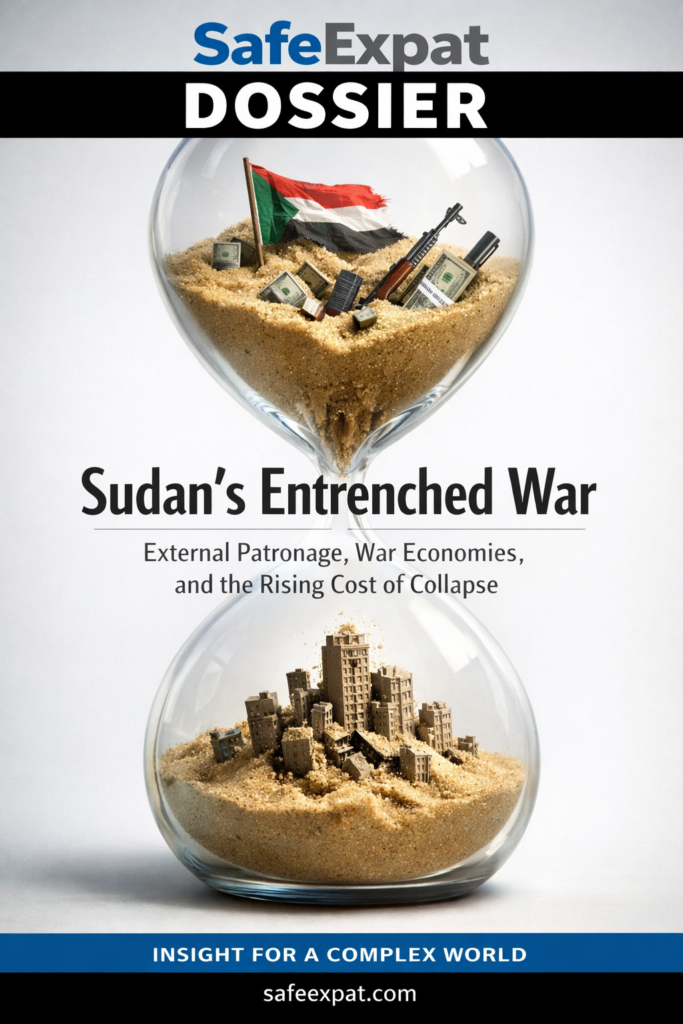
SafeExpat Dossier #XX
Publication date: April 14, 2026
Geographic scope: Sudan, with regional spillover across Chad, South Sudan, Egypt, the Red Sea corridor, and Gulf-linked supply networks
Risk classification: High
Sudan’s war endures because it is no longer only a domestic power struggle between the Sudanese Armed Forces (SAF) and the Rapid Support Forces (RSF). It has become a conflict sustained by external backers, fragmented regional diplomacy, localized armed coalitions, and economic incentives tied to territory, commodities, and coercive control.
As the conflict reaches its third anniversary and enters a fourth year, the battlefield has hardened into an east-west divide: the army has regained Khartoum and retains the east, while the RSF remains entrenched across much of western Sudan. This reduces the likelihood of a quick military decision while increasing the risk of de facto partition, protracted attrition, and chronic civilian exposure.
The strategic environment has worsened further in 2026 because the US-Israeli war on Iran and disruption around the Strait of Hormuz have raised fuel, freight, and fertilizer costs globally. For Sudan, that means higher prices for imported essentials, more expensive aid delivery, tighter donor budgets, and deeper food insecurity in a country already facing mass displacement, famine conditions in some areas, and severe institutional collapse.
Executive Intelligence Brief
Sudan remains one of the highest-risk operating environments in the world because violence, state fragmentation, and external interference reinforce one another. The war is not persisting solely because neither side can fully win; it is persisting because both sides still have enough external support, internal revenue, and coercive infrastructure to keep fighting.
Five Key Findings
- The conflict is structurally sustained by foreign backing.
External military and political support has increased both sides’ staying power. Recent analysis points to Egypt, Russia, Iran, and Turkey as suppliers of drone capability or support to the SAF, while the RSF has benefited from UAE-linked weapons and logistics routes through multiple neighboring states and territories. - Sudan is moving from nationwide contestation toward divided control, not peace.
The SAF’s recapture of Khartoum improved its strategic position, but it did not end the war. Current assessments indicate a divided Sudan: army control in Khartoum and the east, RSF control in the west, with Kordofan as a key contested hinge zone. - Humanitarian deterioration is still accelerating.
Around 14 million people have been displaced since the war began, including roughly 9 million internally displaced and around 4 million in neighboring countries. Humanitarian need remains severe, and acute food insecurity is widespread. - Famine and health collapse are no longer peripheral risks.
Famine or famine risk has been identified in multiple areas. Malnutrition, healthcare disruption, and attacks on medical facilities continue to deepen the emergency. - Regional shocks are compounding internal collapse.
The Iran war and Hormuz disruption have pushed up energy and freight costs globally. For Sudan, this means slower aid pipelines, higher transport costs, and even greater pressure on already fragile food and medical supply chains.
Three Emerging Risks
- Entrenched partition risk: A de facto split between army-held east/center and RSF-held west could normalize rival administrations and long-duration insecurity.
- Escalating drone warfare: Rising use of drones and aerial bombardment is increasing the lethality of attacks on civilians and infrastructure.
- Aid system compression: Donor cuts, rising transport costs, and regional supply chain disruption are shrinking humanitarian coverage even as needs rise.
Three Strategic Recommendations
- Assume prolonged fragmentation, not imminent peace.
- Reprice logistics, food, and duty-of-care assumptions.
- Monitor external diplomatic and sanctions shifts as operational variables.
Overall Risk Rating
High, with Very High sub-risks for humanitarian operations, civilian safety, supply-chain continuity, and legal/compliance screening in conflict-linked transactions.
Most Exposed Groups
The most exposed groups include:
- Sudanese residents in contested areas
- Aid agencies and contractors
- Traders dependent on cross-line transport
- Investors with Sudan-linked counterparties
- Regional logistics operators
- Cross-border employers
- Remote professionals or expatriate-linked households relying on banking, telecoms, and transport continuity
Strategic Context
Sudan matters now because the conflict has shifted from acute collapse into chronic strategic fracture. In the first phase of the war, the dominant question was whether one side would overrun the other. In the current phase, the more important question is whether the war is hardening into a long-duration system of divided sovereignty, competing external patrons, and localized war economies.
That distinction matters because the operational implications of stalemate are often more damaging for business, aid access, and civilian mobility than short bursts of intense combat.
Recent developments have intensified that risk rather than reduced it. The SAF’s retaking of Khartoum in 2025 created a perception in some external circles that momentum had shifted decisively. But the RSF remains militarily relevant, especially in western Sudan, and continues to contest strategic corridors in Kordofan. Battlefield momentum has not translated into conflict resolution.
Structural Forces Shaping the Environment
Four forces define the current environment:
- both sides remain embedded in networks of foreign state and non-state support
- both sides benefit from war-related revenue and control systems that create incentives against compromise
- mediation remains fragmented across competing international forums and sponsor states
- civilian systems such as health, food, banking, transport, and local governance have degraded to the point that even static front lines generate expanding human and operational losses
Why This Matters Beyond Sudan
The war is reshaping:
- regional refugee flows
- Red Sea and Gulf-linked logistics
- donor allocation
- sanctions policy
- the security posture of neighboring states
It is also a case study in how fast a national operating environment can move from political uncertainty into multi-layered systemic breakdown.
Why Misjudging the Issue Creates Consequences
Misjudging Sudan creates real financial, legal, and operational consequences. A firm may incorrectly assume that army control of Khartoum means normalized administrative capacity. An NGO may underestimate the cost and fragility of supply corridors. An investor may miss sanctions exposure or beneficial-ownership risk in conflict-linked procurement or logistics.
In Sudan, the gap between nominal control and functional operating capacity is often decisive.
Multi-Dimensional Risk Analysis
A. Economic & Financial Exposure
The primary economic risk is extreme market dislocation. Sudan’s productive economy has been heavily damaged by warfare, displacement, looting, market destruction, and the collapse of transport corridors.
A second primary risk is inflationary pressure from external energy and fertilizer shocks. The Iran war has lifted oil and freight costs globally, and these costs pass quickly into food distribution, water trucking, generator use, private security, and medical supply chains.
Primary Risks
- market destruction and production collapse
- inflation driven by imported fuel and freight costs
- food supply disruption
- transport corridor instability
Secondary Risks
- payment disruption
- banking fragmentation
- currency instability
- informal checkpoint fees
- coercive monetization of access by armed actors
Probability and Impact
- Probability: High
- Impact: High
Most Exposed
- importers
- aid agencies
- transport contractors
- firms with payroll or procurement exposure
- households dependent on remittances
B. Legal & Regulatory Risk
Sudan’s legal risk is shaped less by coherent domestic rulemaking than by overlapping sanctions, recognition issues, licensing ambiguity, and counterparty exposure.
The primary legal risk is transactional: whether a local supplier, transport broker, mine-linked intermediary, security subcontractor, or beneficial owner sits inside a sanctioned or sanctions-adjacent network.
Primary Risks
- sanctions exposure
- counterparty and beneficial ownership risk
- humanitarian-access compliance complexity
- documentation and licensing ambiguity in fragmented territory
Secondary Risks
- reputational exposure
- insurer scrutiny
- litigation risk tied to atrocity-linked supply chains
- donor compliance failures
Probability and Impact
- Probability: High
- Impact: High
Most Exposed
- investors
- commodity traders
- logistics firms
- NGOs
- insurers
- banks
- donor-funded contractors
- multinational employers
C. Safety & Stability Factors
The primary safety risk is persistent, geographically mobile violence. Large parts of Darfur, Kordofan, and Blue Nile remain active conflict zones, and the conflict is marked by aerial bombardment, drone strikes, sexual violence, and attacks on civilian infrastructure.
Mass displacement is not just a humanitarian indicator; it is a stability indicator. Such levels of displacement degrade social protection, increase extortion and trafficking risk, intensify local competition over land and resources, and generate unpredictable movement patterns that affect roads, services, and border management.
Primary Risks
- active fighting across multiple regions
- drone warfare and aerial bombardment
- civilian targeting
- mass displacement
Secondary Risks
- public health collapse
- attacks on healthcare
- trafficking and exploitation
- spillover instability in neighboring states
Probability and Impact
- Probability: Very High
- Impact: Very High
Most Exposed
- residents in Darfur, Kordofan, and frontier zones
- humanitarian personnel
- local staff of foreign organizations
- transport workers
- women and girls
- children
- refugee-hosting communities in neighboring countries
D. Operational & Administrative Friction
The primary operational risk is that nominal control does not equal usable access. A city or corridor may appear under one actor’s control yet still be subject to checkpoint predation, arbitrary restrictions, infrastructure failure, telecom disruption, and security volatility.
Administrative friction includes visa uncertainty, local authorization mismatches, staff relocation complexity, restricted insurance availability, and limited medevac confidence.
Primary Risks
- unreliable physical access
- checkpoint predation
- damaged infrastructure
- telecom disruption
- logistics fragility
Secondary Risks
- visa and permit uncertainty
- insurance restrictions
- limited evacuation confidence
- growing administrative burden for compliant operations
Probability and Impact
- Probability: High
- Impact: High
Most Exposed
- NGOs
- regional employers
- project-based contractors
- field researchers
- media teams
- operators dependent on cross-line movement
Scenario Analysis
Scenario 1: Prolonged Divided Sudan
Description:
The SAF consolidates Khartoum and eastern zones while the RSF preserves control in much of the west. Front lines remain active in Kordofan and parts of Blue Nile. International diplomacy produces declarations but not a unified enforcement mechanism.
Probability: High
Impact: High
Early Warning Indicators:
- steady but inconclusive fighting in Kordofan
- continued RSF administrative signaling in western Sudan
- absence of direct SAF-RSF talks
- continued allegations of external support flows
- no durable humanitarian truce
Mitigation Strategies:
- plan around geographic compartmentalization
- separate east-based and west-based exposure models
- avoid assumptions that Khartoum’s partial recovery implies nationwide normalization
- update sanctions and counterparty screening frequently
Scenario 2: Battlefield Escalation Around Kordofan and Darfur Corridors
Description:
The war intensifies around strategic routes linking central Sudan to Darfur, with both sides trying to convert positional control into leverage over future statehood or partition terms.
Probability: Medium-High
Impact: Very High
Early Warning Indicators:
- rapid shifts around strategic corridors
- increased drone incidents against infrastructure and civilian areas
- public mobilization by allied militias
- new reports of arms flows
Mitigation Strategies:
- reduce road dependence where possible
- increase stock buffers
- tighten no-go criteria
- rehearse hibernation and relocation triggers
- map route denial contingencies for fuel, water, and medical resupply
Scenario 3: Limited Humanitarian Truce Without Political Settlement
Description:
Outside powers support a time-bound humanitarian arrangement. Fighting decreases temporarily in select areas, but the underlying political and military contest remains unresolved.
Probability: Medium
Impact: Medium-High
Early Warning Indicators:
- convergence among key external actors
- corridor-specific access agreements
- improved aid deconfliction
- rhetoric shifting from maximalist victory to conditional pauses
Mitigation Strategies:
- treat any truce as operational breathing room, not strategic resolution
- move inventory during the window
- refresh vendor due diligence
- reassess exposure before re-entry or expansion
Scenario 4: Regional Shock Deepens Humanitarian Collapse
Description:
Even without major battlefield change, aid cuts, high fuel prices, and constrained logistics worsen famine, disease, and displacement.
Probability: High
Impact: Very High
Early Warning Indicators:
- further ration cuts
- more kitchen closures
- more clinics reporting stockouts
- worsening refugee assistance in Chad and South Sudan
- higher transport and freight surcharges
Mitigation Strategies:
- prioritize cash-flow resilience
- build redundant procurement channels
- strengthen medical contingency planning
- ring-fence critical staff welfare, communications, and fuel reserves
Practical Risk Mitigation Playbook
Preparation Checklist
- map exposure by geography, not by national label
- differentiate between Khartoum/east, Kordofan, Darfur, and neighboring-state spillover exposure
- update all assumptions on access, prices, and time
- identify essential dependencies such as fuel, telecoms, cash access, road movement, medical referral, and local permissions
Financial Safeguards
- maintain higher cash and working-capital buffers than normal
- stress-test procurement and payroll against fuel spikes, route loss, and delayed transfers
- screen all counterparties for sanctions and conflict-linkage risk
- diversify sourcing and transport channels
Legal and Compliance Review Points
- review whether activities intersect with listed persons, listed entities, or conflict-enabling supply chains
- reassess beneficial ownership and local partner relationships regularly
- document humanitarian or operational necessity
- track changes in sanctions and political recognition
Insurance Considerations
- expect narrower coverage and more exclusions
- verify trigger definitions and geographic exclusions in writing
- reassess war, political violence, medical evacuation, and supply disruption clauses
Contingency Planning Measures
- set hard triggers for relocation, hibernation, or suspension
- build family and staff plans around degraded systems
- prepare neighboring-country fallback options
- assume intermittent healthcare, slower evacuation, and greater reliance on self-managed reserves
Ongoing Monitoring Checklist
- Kordofan front-line movement
- sanctions and enforcement changes
- fuel, freight, and fertilizer shocks tied to Hormuz disruption
- humanitarian pipeline indicators such as ration levels, clinic stockouts, and access approvals
- evidence of patron-state recalibration or new arms routes
Exposure Patterns & Case Insights
Case Insight 1: The Khartoum Normalization Error
A mid-sized service provider sees the army’s recapture of Khartoum and assumes commercial and administrative normalization has resumed. It reactivates suppliers, reassigns staff, and shortens inventory buffers. Within weeks, it discovers that formal control has not restored dependable road security, medical support, or payment continuity.
Common miscalculation: equating battlefield symbolism with system recovery
Avoidable exposure: under-budgeted logistics, staff welfare failures, weak evacuation assumptions
Lesson: operational viability in post-battle urban areas depends on institutions and services, not just flags over buildings
Case Insight 2: The Compliance Blind Spot in Subcontracting
An organization conducts diligence on its prime local partner but not on warehouse, trucking, and facilitation subcontractors. Later review reveals exposure to individuals or networks linked to sanctioned or conflict-benefiting actors.
Common miscalculation: screening the first layer only
Avoidable exposure: sanctions breach risk, donor scrutiny, reputational damage
Lesson: in Sudan, second- and third-tier counterparty screening is often more important than headline partner review
Case Insight 3: The Humanitarian Budget Trap
A relief operator budgets for known local insecurity but not for regional fuel and freight shocks. When Hormuz disruption raises logistics costs and donor funds tighten, food deliveries slow, clinic supplies run low, and local kitchens close.
Common miscalculation: treating security risk and supply-chain risk as separate categories
Avoidable exposure: program interruption, contractual underperformance, beneficiary harm
Lesson: in fragile environments, macro shocks become field risks almost immediately
6–12 Month Outlook
The most plausible trajectory over the next 6–12 months is continued fragmentation, punctuated by localized offensives and diplomacy that remains narrower than the conflict itself. A comprehensive settlement remains unlikely unless the principal external patrons converge on a common sequencing framework and back it with meaningful enforcement.
Signals to Monitor
- sanctions expansion
- tighter scrutiny on external backers
- arms-route interdiction
- shifts in global fuel and fertilizer markets
- changes in humanitarian corridor arrangements
- reduced or increased drone attacks
- food and health pipeline metrics
Indicators of Stabilization
- sustained humanitarian corridor arrangements
- reduced drone attacks
- coordinated sponsor-state pressure on both belligerents
- improvement in food and health delivery metrics
Indicators of Escalation
- major offensive in Kordofan
- deeper entrenchment of rival governance structures
- deterioration in Chad or South Sudan refugee support
- prolonged Middle East market disruption keeping fuel prices elevated
Strategic Conclusion
Sudan’s core exposure level remains high because the war is being sustained by a combination of external patronage, territorial fragmentation, war-economy incentives, and severe institutional collapse.
The central analytical error is to view the conflict as a stalled domestic duel that simply awaits mediation. In reality, Sudan is a regionalized conflict system whose internal dynamics are reinforced by outside actors, sanctions complexity, and macroeconomic shocks.
Who Should Proceed Most Cautiously
- anyone needing predictable mobility
- anyone requiring physical presence
- organizations dependent on regulated transactions
- operators relying on fixed-cost assumptions
- aid implementers
- regional employers
- logistics firms
- insurers
- investors
- families dependent on medical or administrative continuity
Who May Still Operate Comparatively Better
Actors able to:
- segment geography carefully
- tolerate volatility financially
- maintain strong compliance discipline
- use rolling intelligence rather than static assumptions
Even then, the operative word is not opportunity but selectivity.
Strategic Positioning Recommendation
The correct posture is neither panic nor complacency. It is disciplined exposure management: narrow the footprint, test assumptions constantly, separate symbolic gains from functional recovery, and treat external geopolitical shocks as immediate variables in Sudan decision-making.
Why Ongoing Intelligence Matters
Reactive decision-making is expensive in fragmented conflict environments because the visible event is rarely the full risk. By the time a battlefield shift, sanctions change, or supply disruption becomes obvious, the financial and operational damage is often already underway.
Outdated or fragmented information is especially dangerous because Sudan’s risk picture now evolves across several layers at once:
- local armed movement
- cross-border patronage
- sanctions policy
- humanitarian access
- refugee pressure
- wider regional commodity shocks
A user who monitors only one of those layers may miss the actual driver of the next disruption.
The asymmetry of risk in unfamiliar environments is stark. A single missed sanctions connection or an overly optimistic logistics assumption can impose costs far greater than the apparent savings from lighter diligence. The same is true for households and mobile professionals: an environment may look manageable until healthcare access, cash movement, or safe transit fails at the same time.
Structured monitoring reduces that exposure because it forces decision-makers to revisit assumptions continuously and connect issues that are too often treated separately: security, regulation, transport, food systems, and regional geopolitics.
For globally mobile individuals and organizations, this is where SafeExpat has strategic value: not as a one-time source of country background, but as a standing intelligence discipline that tracks how economic, legal, and stability conditions interact across borders and over time. In environments like Sudan, continuous situational awareness is not informational convenience. It is a practical method of reducing financial, legal, operational, and personal risk exposure.