Editorial Product
SafeExpat DOSSIER
Executive Summary
Tanzania has formally advanced a major multimodal transport corridor connecting Dar es Salaam with Kigoma and the wider Great Lakes region.
On 20 July 2026, President Samia Suluhu Hassan marked the construction of the Tabora–Kigoma Standard Gauge Railway section and launched four new cargo vessels for Lake Tanganyika alongside expansion works at Kigoma Port.
The projects could eventually improve freight access between Tanzania, eastern Democratic Republic of the Congo, Burundi and other regional markets. However, the immediate significance is increased construction activity and corridor preparation—not the availability of a new operational transport route.
Organizations should begin evaluating the corridor as a future logistics alternative while continuing to rely on established routes until railway, port, vessel and cross-border systems are fully operational.
Signal
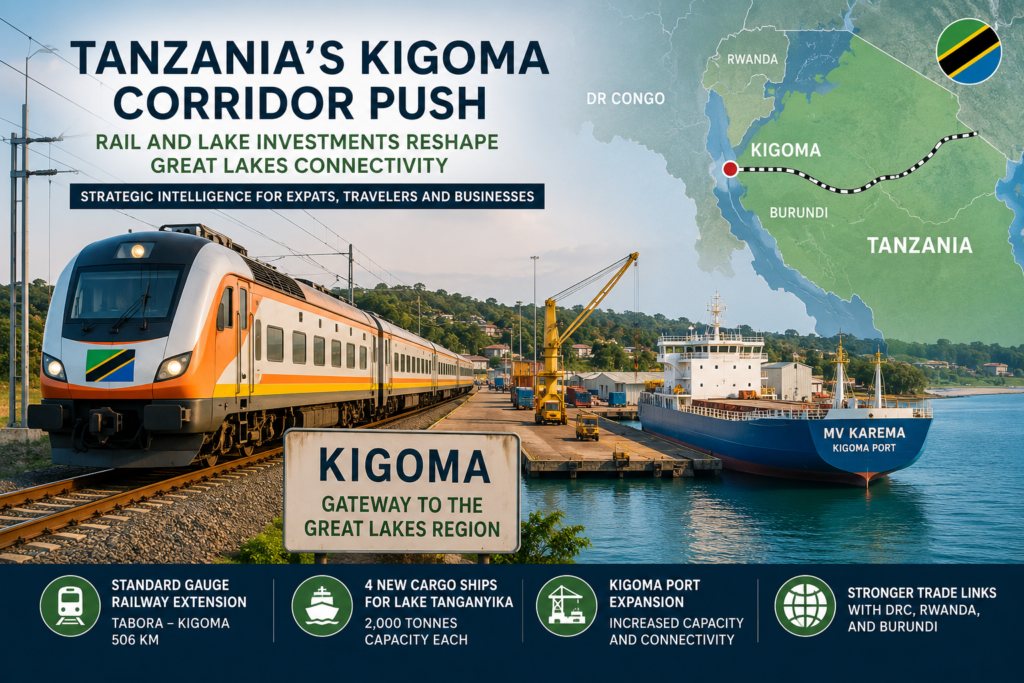
Tanzania has formally launched the sixth section of its electrified Standard Gauge Railway network, covering approximately 506 kilometres between Tabora and Kigoma.
The project is intended to extend the developing SGR corridor westward from Dar es Salaam toward Lake Tanganyika. Current reporting places the project value at approximately TSh6.31 trillion and indicates that construction has already progressed beyond 10 percent.
The railway announcement was accompanied by the launch of four cargo vessels intended for Lake Tanganyika operations. Each vessel is reported to have capacity for approximately 2,000 tonnes of cargo. Kigoma Port expansion works include new cargo and passenger berths and dredging intended to increase navigable depth and handling capacity.
Tanzania Ports Authority information indicates that the four-vessel project began in April 2025 and had exceeded 95 percent completion by March 2026, with final inspections and regulatory procedures still required before full service.
The July 2026 event should therefore be understood as a formal acceleration and political endorsement of an existing infrastructure programme rather than the immediate opening of a functioning rail-and-lake corridor.
Assessment
The strategic significance lies in the combination of railway, port and lake-transport capacity.
The Tabora–Kigoma railway is designed to connect western Tanzania with the developing electrified corridor leading toward Dar es Salaam Port. The Lake Tanganyika vessels could then provide an onward freight connection to ports and commercial centres serving eastern DRC, Burundi and Zambia.
This creates the foundations of a multimodal route linking the Indian Ocean with the Great Lakes region. Tanzania Railways Corporation describes the broader SGR network as a system intended to connect Dar es Salaam, Mwanza, Kigoma and neighbouring markets, including Rwanda, Burundi and the DRC.
For internationally exposed organizations, the corridor could eventually provide:
- An additional route for cargo entering or leaving eastern DRC.
- Improved access to western Tanzania and the Lake Tanganyika basin.
- Greater competition between regional ports and transport corridors.
- Reduced dependence on long-distance road freight.
- New opportunities in logistics, mining support, infrastructure, construction and regional distribution.
The operational benefits will not be immediate. They depend on the synchronized completion of railway sections, port works, vessel certification, cargo-handling systems, customs procedures and connecting infrastructure on the opposite side of Lake Tanganyika.
A reported proposal to improve road connectivity between the mining area of Manono and Kalemie Port in the DRC illustrates this dependency: the Tanzanian assets will deliver their full value only when inland feeder routes and cross-border systems are capable of supplying consistent cargo volumes.
Exposed Groups
The developments are most relevant to:
- International logistics and freight-forwarding companies.
- Mining companies and suppliers operating in eastern DRC.
- Infrastructure contractors and engineering firms.
- Expatriates and foreign personnel based in Kigoma, Tabora and western Tanzania.
- NGOs and humanitarian organizations operating around Lake Tanganyika.
- Businesses importing equipment or exporting commodities through Dar es Salaam.
- Global mobility and security teams supporting personnel in Tanzania, Burundi and eastern DRC.
- Investors assessing warehousing, transport, hospitality and industrial opportunities.
- Local partners involved in customs clearance, road transport, marine services and cargo handling.
- Business travelers and technical personnel visiting railway, port and construction sites.
Operational Impact
Near-Term Construction Exposure
Increased activity along the Tabora–Kigoma corridor may produce localized road diversions, heavy-vehicle movements, contractor mobilization and pressure on accommodation and support services.
Organizations moving staff through construction areas should anticipate changing access conditions and increased traffic near project compounds, material-storage areas and railway crossings.
Logistics Planning
The projects may encourage logistics operators to reassess future routes between Dar es Salaam, Kigoma, Kalemie, Bujumbura and other Great Lakes destinations.
The corridor should not yet be treated as a dependable alternative for time-sensitive cargo. Operational schedules, vessel certification, rail completion dates, port-handling procedures and customs arrangements require further confirmation.
Commercial and Investment Exposure
Kigoma may attract additional warehousing, freight consolidation, marine services, accommodation and contractor activity.
Early investment may offer commercial advantages, but organizations should avoid basing financial projections solely on announced throughput, completion dates or projected cargo volumes.
Personnel Mobility
The railway could eventually reduce journey times and improve passenger access to western Tanzania. Current reporting suggests that the completed corridor may significantly shorten travel between Dar es Salaam and Kigoma.
Until the full route is commissioned, personnel should continue to plan around existing air, road and conventional railway options.
Cross-Border Compliance
Greater freight movement through Lake Tanganyika could increase demand for customs brokers, port agents, immigration support and cargo documentation.
Differences between Tanzanian, Congolese and Burundian customs processes may initially create delays even after physical infrastructure becomes available.
Safety and Environmental Exposure
Increased rail, port and vessel activity will require stronger controls around construction safety, lake navigation, dangerous-goods handling and emergency response.
Organizations operating on Lake Tanganyika should continue to verify vessel certification, weather conditions, insurance coverage and operator safety standards rather than assuming that newly introduced capacity automatically provides reliable service.
Likelihood
Moderate
Continued construction activity, contractor mobilization and gradual port-capacity expansion are likely.
However, the probability of major near-term changes to established passenger or freight routes remains moderate because several interconnected assets must be completed and commissioned before the corridor can operate as an integrated system.
Delivery timelines also require monitoring. Current reporting connected to the July 2026 launch references completion around 2030, while earlier Tanzania Railways Corporation communication indicated possible Tabora–Kigoma operations after completion in 2028.
This difference does not undermine the project’s strategic direction, but it indicates meaningful schedule uncertainty.
Time Horizon
3–6 months
This period will be important for assessing whether the formal launch produces measurable acceleration in construction, port works and vessel deployment.
Key developments may include contractor mobilization, final vessel certification, publication of operating schedules, progress on Kigoma Port dredging and confirmation of updated railway milestones.
The full regional mobility and trade effects are likely to emerge over several years rather than within this assessment window.
Recommended Actions
For logistics and supply-chain teams
Map the potential Dar es Salaam–Kigoma–Lake Tanganyika corridor as a future alternative, but do not replace established routes until end-to-end operations have been demonstrated.
Request verified information on sailing schedules, cargo restrictions, handling capacity, insurance arrangements and customs procedures before contracting lake transport.
For companies and investors
Conduct demand-based assessments rather than relying only on announced infrastructure capacity. Evaluate actual cargo commitments, connecting-road conditions, port charges and regulatory requirements.
Include construction delays, customs friction and incomplete feeder infrastructure in financial scenarios.
For NGOs and field organizations
Review whether improved Kigoma connectivity could support future access to western Tanzania, Burundi or eastern DRC.
Maintain existing evacuation, medical-transfer and personnel-movement arrangements until the new transport system has established a reliable operational record.
For global mobility and security teams
Monitor accommodation availability, road access and contractor activity in Kigoma and communities along the railway alignment.
Brief personnel that a project launch does not mean passenger services are available. All bookings and movements should continue to be confirmed directly with authorized operators.
For marine transport users
Verify vessel licensing, safety equipment, operator credentials, weather conditions and cargo insurance before using new services on Lake Tanganyika.
Watch Indicators
Monitor:
- Tanzania Railways Corporation progress reports for the Tabora–Kigoma section.
- Confirmation of revised construction and commissioning deadlines.
- Certification and commercial deployment of the four Lake Tanganyika vessels.
- Publication of vessel schedules, tariffs and permitted cargo categories.
- Completion of dredging and new berths at Kigoma Port.
- Customs or immigration agreements affecting lake-based cross-border movements.
- Development of the Manono–Kalemie connection and other DRC feeder routes.
- Port investment or cargo agreements involving mining companies.
- Land compensation disputes or community opposition along the railway alignment.
- Construction accidents, security incidents or significant project delays.
- Changes in cargo volumes through Dar es Salaam and Kigoma.
- Embassy, government and transport-operator notices affecting personnel movement.
Confidence Level
High
The formal railway event, the scope of the Tabora–Kigoma project and the development of four cargo vessels are supported by Tanzania Ports Authority information and multiple recent Tanzanian reports.
Confidence is lower regarding exact completion dates, future throughput and projected economic benefits. These remain dependent on construction performance, regulatory approval, cross-border coordination and commercial demand.
SafeExpat Assessment
Tanzania is developing a multimodal trade corridor rather than a collection of isolated transport projects.
The strategic signal is a gradual shift in the Great Lakes logistics map, with Kigoma positioned as a potential transfer point between Dar es Salaam, western Tanzania and markets across Lake Tanganyika.
The corridor does not yet create an immediate alternative for routine personnel or cargo movement. Its importance lies in the direction of travel: organizations active in Tanzania, Burundi and eastern DRC should begin integrating Kigoma into long-term mobility and supply-chain planning while waiting for verified operational capability.
SafeExpat assesses that the opportunity is credible, but execution—not political launch—will determine whether Kigoma becomes a dependable regional gateway.